Showing posts with label Presidents. Show all posts

Friday, November 20

The Problem With the President's Popularity

President John Tyler
By Art Cashin

On this day (-2) in 1843, a President learned that messages from the public at half term can sometimes be unfriendly. His name was John Tyler. As you recall from fourth grade, Tyler - the back half of "Tippecanoe and Tyler Too" - had ascended to the presidency when the front half (William H. Harrison) caught the attention of the Guinness people by dying after only thirty days in office.

Anyway, Tyler stepped in and seemed never to capture the popularity of his predecessors almost from the day he took office. Even his wife was somewhat controversial. Some thought she was a bit too pushy or up-front.

Frustrated by newly sagging polls and some Congressional election reversals, Tyler decided to take a small vacation - a little trip. He sent his son down to the railroad station to arrange a special train for the trip. The station master and his staff told the young man something like - "We don't provide special trains for politicians." Young Tyler responded by noting that the B&O had made a special train available for the corpse of the late President Harrison. The station master reportedly said - "Bring me your father in the same shape as President Harrison and we'll be glad to get him a train."

To mark how far we've come since those hostile old days go visit some affable office holders. But don’t mention anything to the folks running for President.

Many thanks to Mr. Cashin and UBS Financial Services who graciously allow his historical musings to be republished on this site. To enjoy more of Art's posts simply click on "Cashin's Comments" in the label section on the sidebar.

Editor's Note: Here is another article about Tyler that I wrote in the past. You might enjoy re-visiting it.   Grant Davies

Wednesday, February 26

Marbury v Madison - It's Simple Once You Get Past the Complexity

William Marbury
By Art Cashin

On this day (-1) in 1803, the U.S. Supreme Court assumed immense power by announcing that it lacked power. In that single act it threw a curve-ball past a hostile President and redefined the Constitution. And this is how it happened.

When John Adams lost the Presidency to his adversary, Thomas Jefferson, Adams rushed to fill lots of political posts before the new guy got in. In that rush, the Secretary of State forgot to get all the appointments posted before Adams' term expired.

So, Jefferson said the appointments were invalid and he could appoint his own guys. One of Adams' appointees decided, in what has become an American tradition; to sue to get the job he was promised. His name was William Marbury, and he sued the incoming Secretary of State, a guy named James Madison. So, naturally when it hit the Supreme Court docket, it was called "Marbury vs. Madison" (now known as,
perhaps, the most important judicial decision in U.S. History).

The Chief Justice was a guy named John Marshall. Since he was appointed to the Court by Adams, Messrs. Jefferson and Madison figured they would not get a fair shake. So they told associates that if Marshall found for Marbury they would ignore the Court and hide all its quill pens.

So, Marshall was in a quandary. He knew that Marbury had a good case but to decide in his favor could destroy the Court. He decided to throw one of the biggest curveballs in judicial history. He wrote that Jefferson & Madison were probably wrong guys who might have put gum on folks’ seats during the Constitutional Convention. He said Marbury clearly deserved his post. EXCEPT - - - - (and this was the big one) - - - - the act under which Congress had granted to the Supreme Court the right to mediate appointment disputes (the Judiciary Act of 1789) was unconstitutional.

Thus Jefferson was presented with a decision that said - - You don't have to give Marbury the job because I don't have the power to make you give Marbury the job because I have decided the law that gave me that power was unconstitutional. (And now since I demonstrated that I have the power to interpret the Constitution that gives me more power than you or Congress now have.)

The decision forever changed American history, politics and government. Marshall is universally renowned as the most important Chief Justice in history (mainly for this decision). But the answer to one of the twelve best bar bets of all time (call our 900 number for clues) is - - - - who was Adams' dopey Secretary of State, whose error set up the whole crisis. Okay so you guessed it. Yup! The same John Marshall - - himself a last minute appointment - - to the Supreme Court.

Many thanks to Mr. Cashin and UBS Financial Services who graciously allow his historical musings to be republished on this site. To enjoy more of Art's posts simply click on "Cashin's Comments" in the label section on the sidebar.

Wednesday, October 16

The Day the Bartender Gave Teddy a Shot

Image = 9gag.com
By Art Cashin

On this day (-2) in 1912, former President Teddy Roosevelt was out on the stump trying to regain the highest office in the land. He was trying to unseat Taft, his handpicked successor. Since the Republicans decided to stick with the incumbent, Taft; Teddy had to form his own party - the Progressive. But the press renamed the Progressive's - The Bull Moose Party after Teddy had said he felt as fit as a bull moose.

Anyway, this day found Teddy in Milwaukee on his way to deliver a speech. Quietly, through the crowd, moved a certain John Schrank, a New York bartender. He reached between two people trying to shake the candidate's hand, and fired a bullet straight into Teddy's chest.

The force of the shot knocked Teddy back against a parked car as the crowd wrestled Schrank to the ground. His aides ran to Roosevelt and urged him to go to the hospital. He pointed out there was no blood around the bullet hole in his lapel and damn-it he had come to give a speech.

He walked to the podium and pulled his speech from his inside jacket pocket. Only then did he notice that the bullet had gone through all 100 pages of the double folded speech. What he didn't know was that the bullet had gone four inches into his chest. And the reason there had been no blood was that the speech had compacted around the wound.

But Teddy meant to give a speech and a speech he gave - for over 50 minutes. Then, as the crowd cheered, he bowed and finally agreed to go to the hospital, where he was treated for shock and extreme blood loss.

To celebrate stop by the Rough Rider Lounge and have an ice-worm cocktail or two. And toast the fact that public officials today are probably as plucky and gritty as Teddy (try to say it with a straight face).

Many thanks to Mr. Cashin and UBS Financial Services who graciously allow his historical musings to be republished on this site. To enjoy more of Art's posts simply click on "Cashin's Comments" in the label section on the sidebar.

Monday, August 26

Own a Judge

Image = US History.org

By Grant Davies

No, this is not a story about the justice system in Chicago. It's the story of a remarkable young lady from a different time. Her name was Ona Judge.

It was May 24th, 1796, when the chance meeting of our subject and an acquaintance took place on a Portsmouth, New Hampshire street.  A twenty year old girl named Oney (Ona) Judge was hailed down by Elizabeth (Bets) Langdon,  just a teenager herself, who recognized her. Bets knew Oney because her father was a Senator and Oney worked for a friend of his. Oney had run away from home, Bets knew about it, and couldn't understand why. Reportedly, the conversation went like this;

"Why Oney, where in the world did you come from?"
"Run away missis."
"Run away! You had a room to yourself, and only light, nice work to do, and every indulgence..."
"Yes..I know..but I wanted to be free, missis."*

Now, I know you're thinking to yourself, "What's so interesting about this story? Kids run away from their homes all the time so they can have their freedom. Big deal!" Well...Oney wasn't running away from her parents. She was a slave running away from her master and her mistress.

And the person who owned Ona wasn't just any slave owner. The person just happened to be Martha Dandridge Custis. Anyway, that was her name before she remarried following the death of her husband, Daniel Parke Custis. Her name changed to Martha Dandridge Custis Washington when she remarried a guy named George Washington. You may have heard about him when reading some of our earlier stories. (We've written about or mentioned him in no less than a dozen previous stories.) But enough about her owners; they are well known enough.

This story is about Ona and what she did with her life after she became one of the first people to use the Underground Railroad. In her case, the railroad was actually a ship, the "Nancy" by name. She boarded it the same day she casually walked away from the President's house in Philadelphia, right in the middle of the family's supper. The soup must have been pretty tasty; they never looked up long enough to notice her leaving with her suitcase.

The ship was sailing north and she disembarked in Portsmouth where the chance encounter with the Senator's daughter took place some time later. She spent the rest of her life trying to bargain with the President for her freedom and dodging the agents he sent to retrieve her. She even offered to return if he would agree to free her in his will. Apparently he wasn't interested in negotiating with a slave, particularly one who he considered part of the family. The Washingtons were quite fond of her, having raised her since she was ten when she became Martha's attendant. It's said that Martha was heartbroken.

Oddly, she was once hidden and protected by the same Senator (John Langdon) whose daughter had accidentally spilled the beans concerning her whereabouts. Later she married a free man, had three children, became a widow, and lived most of her life in circumstances far below that which she could have had by staying with the first "First Family." Escaping into poverty and hardship from privilege and comfort says everything that can be said about the value of liberty in 1796.

I hate to point out the irony, but the populace of the country today seems to have chosen the exact opposite.

To celebrate the life of this freedom loving girl, stop down at Nancy's Underground Railroad for some supper and a drink. But don't leave right in the middle of dinner unless you want the owner to send people looking for you.

 * text taken from the excellent book Here is Where, by Andrew Carroll

Thursday, August 8

The Country Needs a Little Rebellion Every Once in a While

By Art Cashin

On this day (-1) 219 years ago (that would be August 7, 1794 if you happen to be saddled with a graduate degree in accounting but have no batteries for your calculator), the President of the United States was told by his aides that he had to get focused. They warned him that his popularity was slipping...that many of the people worried that he was trying to expand the government's authority and size...and that much of his problem related to three areas: taxes, exports and access to medication. Finally, they told him most of his trouble may have been stimulated by his political opponents....the Republicans.

In this case, the President was George Washington...the "Republicans" were what they called Jefferson's supporters at the time (they later changed their name to Democrats)...the tax was an excise tax engineered by Alexander Hamilton...the export question dealt with the shipments down the Ohio and Mississippi...and the medication in question was, of course, alcohol...er in this case whiskey. (Now wait...don't scoff...there was no anesthesia yet and the only other means of sterilization was fire..."Sarge, we've got to get that arrow out or Bob will die!" "Okay, pour some whiskey on this knife and give Bob a gulp for the pain.") We understand there also may be non-medicinal uses of whiskey and hope to hear of them someday.

Anyway, back to the story. At this time, from Pittsburgh, PA to Marietta, Ohio, Frontier folk were growing more corn and grain than they, or anyone, could eat. So they decided to sell it. Since there were no roads at the time, they loaded a couple of barges with corn and sent them toward New Orleans. By the time it got there, the small amount that hadn't rotted and was thus sale-able brought almost no value.

Next they tried feeding the corn to hogs and sending the resultant pork in barges to New Orleans. Given the state of refrigeration at the time, the results were about the same. In fact, the only way the barge crews raised enough money to head back north was by selling a few jugs of whiskey to the medicine hungry folks of New Orleans.

Well, at the time the settlers of this region of Western Pennsylvania and Eastern Ohio were mostly of Scottish and Irish descent. In those politically incorrect days, Scots/Irish were assumed to be good at farming (corn/rye/an occasional buh-day-duh), pharmacology (above mentioned miracle drug) and finance (Adam Smith, etc.). Applying their finance skills, they realized a ton of corn took up a lot of space and barge-wise yielded no profit. Hogs raised on said ton of corn took up less space but still yielded no profit. But...a ton of corn or rye made several barrels of medicine which did yield a profit. And since a barge could hold 5 times more condensed corn (whiskey) than dry corn (corn), the leverage was enormous.

Then along came Hamilton's excise tax. He assumed the product was so valuable that producers could easily pass a tax increase along to consumers. (Maybe genius can be crimped by government service.) The initial reaction was so hostile that Hamilton had to develop a formula. The formula forgave small volume producers and punished high volume producers. Since the East Coast was also making money in tobacco and cotton, that left the Ohio Valley crowd to pay the bulk of the tax.

Although the Scots/Irish of the area were good at farming, pharmacology and finance; their political skills were rudimentary at best.  So they began "tarring and feathering" tax collectors. They even burned tax offices and had bonfires of tax forms. (Where are these people when we really need them?)

Sensing that he was slipping in the polls, Washington followed his aides' advice and sent the army to quell this "Whiskey Rebellion." But...Washington (and the U.S.) had no army so he had to beg for help from the militia of four states. When the "army" hit Pittsburgh, they found most of the rebels were over-medicated so to speak.

The two results of the Whiskey Rebellion were: a) the Federal Government could collect taxes; and b) we needed a standing army (to avoid begging).


Many thanks to Mr. Cashin and UBS Financial Services who graciously allow his historical musings to be republished on this site. To enjoy more of Art's posts simply click on "Cashin's Comments" in the label section on the sidebar.

Wednesday, April 3

The Gipper and the Buck Fifty Dog

image= business insider

By Art Cashin

On this day (-1) in 1984, it was opening day of the baseball season. Of course, the U.S. President was there to throw out the first ball. And because he was a fan - - he stayed. But of course he was a fan. Early on in his life he had made a living broadcasting baseball games in the Midwest. Sometimes he even had to call the game when he wasn't there. He sometimes "reinvented" the game from teletype reports in an office miles from the stadium.

But he was good at it. In fact, he was very good at it. And so the Midwest came to love a radio sportscaster named "Dutch Reagan" and decades later all of America would love Ronald "Dutch" Reagan enough to elect him - - President of the U.S.

So, on this particular day, the fans, the players and the nation were happy to see him sitting in the stands - - with his secret service men - - enjoying America's pastime. Enjoying enough that when the hot dog guy passed by, the President waved his hand and ordered four dogs. The vendor served up four with Kraut and handed them to the President. The President smiled and handed the vendor a crisp $5 bill. Since inflation had raised the price to $1.50 per, the vendor kept his hand out. Since neither Pelosi, Boehner, Reid nor McConnell were present, someone else would have to resolve the issue. After a dramatic pause, an alert secret service guy stood up and made up the right change and included a tip. And, thus a national emergency was again averted.

To celebrate take a deep sip from an empty glass and explain to some young associate that this was surely the first and only time that someone in government ordered more than they had the money to pay for. But make sure your companion is either quite gullible or can't spell deficit.


Many thanks to Mr. Cashin and UBS Financial Services who graciously allow his historical musings to be republished on this site. To enjoy more of Art's posts simply click on "Cashin's Comments" in the label section on the sidebar.

Friday, February 22

Washington's Birthday, It's All Clear Now

Image = rittenhoused.com
By Grant Davies

On this day, February 22, (minus one year and eleven days) in 1732, George Washington was born in Virginia. Well..maybe.

Let's start over again. On February 11, 1731, George Washington was born in Virginia.

And that's why we celebrate his birthday on the third Monday in February, which mathematically cannot occur any later than the 21st. So, as shocking as it may be to observers of  government efficiency, it's a certainty that the country will never celebrate on his actual birthday. Or even his alternate birthday.

And if you are wondering about the year difference, don't blame me, call your congressman. I got the info from an official government site, so it can't be wrong. (I'm a little confused about that.)

Don't panic if you're confused too, we're going to sort this all out for you so you can celebrate it properly on "Presidents Day", which of course doesn't actually exist. Not officially anyway. And as long as we're on the subject, Washington's birthday doesn't count as an official national holiday.

Heck, I'm still confused and I'm the one writing this clarification. So just to be clear, or less un-clear, let's get this all down in bullet points. Just don't use the bullets on me.


  • Washington was actually born on February 11th, 1731. The calender being used some places (like here) at that time was the Julian calendar which was named after the same guy they named the salad for. And if you think this birthday stuff is confusing, just try to figure out the whole change-over thing. The guy who figured it out originally was a few minutes short of a year, if you know what I mean.
  • In 1752, (not sure which day) the Gregorian calendar was adopted, which was named after the same guy they named the chant for. So someone had to tell poor George that he was actually born on February 22, 1732. History doesn't record whether George was surprised, pleased, or chagrined. (Or whether he grinned, for that matter.)
  • Washington's Birthday is not a national holiday, it's a federal holiday. It only applies to federal government employees and the District of Columbia. 
  • "Presidents Day" doesn't actually exist at all, except maybe for certain individual states. It's never been proclaimed by the federal government. In 1968, Congress passed the "Monday Holiday Law", so people, particularly federal employees, could have more three day weekends because everyone was working too hard.
To celebrate this clarification, visit Fraunces Tavern in NYC, where Geo said bye-bye to his troops, and have a toast to clarity. But be sure to stop drinking before things start to get blurry again.


Congratulations to Bob and Sara Aldworth! The 15 Seconds of Fame award for the idea behind this story has gained them a place in history! At least in Cheeky History.  This is the first time this year the award has been given. We hope you will send us great ideas like this too. If we don't keep getting ideas for new posts, we might be history ourselves.

Please don't blame them for the dreadful writing or any inaccuracies we may have committed. It was only their idea, anything awful is my fault.

Tuesday, February 19

In the Line of Fire - A Short Story


On this day (-4) in 1933, a man set out to change history. Now, I know it is hard for you to believe but this guy almost succeeded. Even harder for you to believe this guy was a…..well…..what they used to call a psychopathic malcontent. Now, living in the calm and peace of America in these times you probably wonder what a psychopathic malcontent might be.

Well, in this case, he was altitudinally challenged (4' 10"), authoritatively alienated (his father hit him once), stress raged (his stomach hurt and he threw up occasionally). Not having the opportunity to appear on a talk show he decided the only chance he had to resolve his problems was to kill somebody important.

So, in his late teens, in his native Italy, he decided to kill the King (Victor Emmanuell II). When he discovered the King lived too far away to commute on a donkey, he changed plans.

Eventually, he came to the U.S. Upon arriving in the U.S., he decided to kill the sitting President Calvin Coolidge. But ...lacking a donkey to reach the Prez…..he gave up on the idea. He spent several years pacing about in smoldering hostility. (Remember....no TV talk show outlets.) Then he resolved to kill President Hoover…..until he heard it was cold and snowy in Washington D.C.

Then it all came together. He learned that the President-elect (FDR) was to speak in Miami (rather close to home). So, on this day, he bought a gun and went out to become famous. Much to his surprise he discovered many people had come out to see the President-elect. Now if you are 4' 10", it is not only difficult to shoot the President in a crowd of thousands…..it's difficult even to see him. So, the would-be assassin pushed his way through the human sequoias, jumped up on a chair and started firing. He missed FDR completely but fatally wounded the Mayor of Chicago, Anton Cermak who was travelling with FDR.

The tiny terrorist, Guiseppe Zangara, was arrested on the spot. Within 33 days, he was arraigned, indicted, convicted and electrocuted. (Of course that was before the Patriot Act.)

Many thanks to Mr. Cashin and UBS Financial Services who graciously allow his historical musings to be republished on this site. To enjoy more of Art's posts simply click on "Cashin's Comments" in the label section on the sidebar.

Thursday, January 3

Arrogance is Bliss

 By Grant Davies

On this day (+7) in 1862, a Lieutenant Colonel in the US army fought his first battle in the poorly named Civil War, which has very little to do with this story except that the outcome propelled the Colonel into a Generalship and ultimately the Presidency. Our story today has more to do with a guy named Doctor Bliss. Oh yes, he was a doctor, but his first name was also Doctor. I know, ya can't make this stuff up.

The future President's name was James A. Garfield, but if you are like most folks you know very little about him. In Mrs. Speck's fifth grade class you might have learned that he was assassinated, but like a lot of other things in her class, that information was incorrect. You might also have learned that the guy who killed him was an insaniac named Charles Guiteau, but like the first part, that also was incorrect.

The part about Charlie being insane was correct. In an earlier story on this site he was described by the author as "hearing voices without the benefit of a Walkman." And he shot the President for sure, but he didn't kill him. That achievement should be correctly attributed to our very own Dr. Doctor.

It seems Dr. Bliss was also hearing a voice in his head, but the one he heard was his own. And it was telling him that he was a competent physician. It was also telling him that he was in charge of the heath-care decisions to be made in the treatment of Garfield. 

And speaking of crazy, without being appointed by anyone in particular, and certainly no one with the authority to do so, he injected himself into the situation. He took over by the force of his own authoritative pretense. He then fired all the other doctors who were summoned or otherwise showed up following Guiteau's target practice. And you thought incompetence in government was a recent development?

Bliss was originally summoned to the scene of the crime by none other than Robert Todd Lincoln, a member of Garfield's cabinet, who had been waiting at the train station where the shooting took place. Lincoln just happened to be the son of another President who had been shot, and he had been in the room when his father was abused by incompetent boobs who thought it would be helpful to stick objects into his brain to locate the piece of lead that caused his sudden dullness. Robert remembered that Bliss was one of those boobs, so he naturally thought he was a good candidate to screw this situation up as well. It helps to have experience in these matters.

Anyway, Bliss was as arrogant as he was ignorant, so he decided to dismiss the widespread wisdom of most of the European medical community on the subject of bacteria and infection of wounds. Guys like Bliss had decided that there was no such thing as germs since they couldn't see them. (Joseph Lister would have turned over in his grave except that he was still quite alive.)

It took about two months of continual torture from Bliss, who regularly stuck various contaminated objects into the President's wound, before he succeeded in killing the patient who might very well  have survived otherwise. (And what on earth would the country have done without ole Chet Arthur ascending to the highest position in the land?)

So in the end, crazy Charlie Guiteau only succeeded in getting himself hung by his neck until the voices in his head stopped telling him to shoot the President. And Bliss only succeeded in poking Garfield to death before he submitted a bill to Congress for the service of doing so. It was a huge bill, and for once the Congress did the right thing and refused to pay it. They did agree to pay him a lesser sum (which he refused, in the ultimate act of arrogance) so don't go wild giving them too much credit.

To commemorate the events, enroll in a history course at your local community college. But just make sure the professor isn't the same Mrs. Speck who taught you all the wrong things back in the fifth grade. History does have a way of repeating itself you know.

Information found in this story was mostly gathered from the excellent book on the subject, "Destiny of the Republic" by Candice Millard.

Tuesday, December 18

Who Really Killed Abe Lincoln?

Image = aboutpresidentaberahamlincolnblogspot
By Grant Davies

The month was May, not April, and the assassin of Abraham Lincoln was not named Booth. In  fact, history has never been able to identify the assassin by name.

"Whoa! That can't be right", you say. Your teachers always told you that Lincoln was killed on April 14th at Ford's Theater by John Wilkes Booth, who ended Abe's life with a single shot from behind and escaped afterward. The murder was part of a conspiracy. Abe's wife Mary was left a widow with children to raise. And all the history books back that up. 

But they only had some parts of it correct. He was shot from behind and killed by a single shot all right, and it was part of a conspiracy, but most of the rest is wrong. You see, his son Tom was there, witnessed it, and told his own son all about it later.  He told it carefully and included all the details. And at the time, nobody disputed the facts as they had been recalled by the multiple witnesses. 

Now, as famous radio host Paul Harvey used to say, "Here's the rest of the story."

The year was actually 1786. The assassin was a native American who snuck up behind Lincoln as he chopped wood with his three sons on their homestead in Kentucky. The Indian (as he was called before it became politically incorrect to describe him that way) had a long barreled firearm and shot Abe from a distance. One shot, goodbye. 

As the Indian came forward from the cover of the woods to make sure he had finished the job - and perhaps even dispatch Abe's son Tom - he himself was sent to the "not so happy" hunting grounds where Indians went after they were no longer breathing. Abe's son Mordicai had fetched the family weapon himself after the fracas began and shot the assassin dead.*

By now you have figured out that what we have here is a case of mistaken identity. The Abe Lincoln in this story is not the same one who was President. But the similarities are remarkable. Both Abrahams had sons named Thomas and wives named Mary. And in fact, they were related. Our Abraham and Mary were the President's grandparents and our witness, Tom, was Honest Abe's father.

The unnamed Indian was sent there to kill Lincoln as part of his tribe's conspiring to rid themselves of a man and his family who they regarded (perhaps correctly) as trespassers on their land. In fact, they had driven him off once before, so from their point of view, he had been warned already.

The moral of the story is..well..there is no moral to the story. It's just a cool story because of the way history sometimes repeats itself.

* Not every account of the event agrees on every detail. Some have the perpetrator escaping. But I like the version where the killer gets his just reward. So that's my story and I'm stickin' to it. (Actually, it's Wikipedia's version of the story. And you know if it's on Wikipedia it's always correct.)

Wednesday, December 12

You're a Good Egg, Tom Dewey


By Grant Davies

On this day (-5), in 1941, the Japanese executed a sneak attack on the US Pacific fleet in Pearl Harbor, Hawaii. The world war that ravaged the rest of the globe had finally came to the US.

But this story is only peripherally about that event. This story is about a man who put his own advancement and interests beneath the interests of his country.

Such things were common in those times. Most citizens and virtually every person in the armed services fell into that category. But if you can fathom this, the man in the story was a politician. Crazier things have happened, but not often.

Image= bcfoley.blogspot.com
So let's fast forward a few years. The year was 1944. The man was running for President. His name was Tom Dewey. And Tom knew a secret. The secret he knew was explosive. It would almost certainly assure that he would defeat his opponent, a guy named Franklin D Roosevelt, in the upcoming election.

Tom had it on reliable information that the US had broken the Japanese code prior to the attack on Pearl. The implications were obvious. FDR knew of the plan to attack before it happened and had purposely ignored it so the US could enter the war. FDR wanted to join in, and knew it was inevitable anyway. But people were standing in his way. And it naturally follows that once he knew, all our sailors had died so FDR could get his political way.

The secret was true. The code had indeed been broken, and a pretty important guy named George C. Marshall found out that Dewey knew. Marshall was the US Army Chief of Staff and the situation at the time was desperate. He feared that Dewey might do what almost every candidate today would do with that kind of information, so he sent him a sealed message via a courier named Colonel Carter Clark. Clark caught up with Dewey at his hotel during the campaign.

When he opened the letter from Marshall and read the contents, Tom was initially furious. In the letter, Marshall reminded him of the damage that would be done to the war effort if the Japanese learned that we had broken their code. Based on his own information, and now the admission by Marshall that it was true, Dewey not only thought FDR should be defeated in the election, but that he should be impeached.

But Dewey kept his mouth shut and lost the election without using the only thing that would have insured that he would win. In fact, he never revealed it and took it to his grave. He died in 1971.

But wait a minute. Ten years later some secret documents from the time were declassified. In one of them something was revealed that Dewey never knew. Namely that the code that was cracked was the Japanese diplomatic code, not the military code. The military code wasn't cracked until after Pearl Harbor. FDR hadn't known after all.

So drink a holiday toast to Tom Dewey, who, like Danny Noonan from Caddy Shack, was a good egg and did the right thing even though he had bad information.

Source material for this story was taken from "Destiny", by Paul Aurandt.

Tuesday, September 25

Pardon my Adultery

Image courtesy of Mormon History Guy
By Grant Davies

Presidents can get into political trouble if they make controversial pardons to people who have knowingly broken the laws. It has happened many times in the past.

But if the country elects a Mormon President (or more correctly, a President who is a Mormon), be ready for him to legally forgive all of his fellow Mormons for their crimes of adultery, illegal co-habitation, bigamy, and polygamy. It's an outrage I tell ya!

Oh, that already happened one hundred and eighteen years ago? Umm, in that case.. never-mind.

It was on this day, September 25th, 1894, that President Grover Cleveland, who turned out to be a two timer himself (in an electoral way), issued a pardon to all the Mormons who committed the above named crimes. I apologize for the confusion.

It seems these issues never get totally resolved, because now-a-days a bunch of other people are agitating to be allowed to define marriage in their own way. But that's a different story. I'll tell you all about it someday.

It was only after the Church of Latter Day Saints made it's own proclamation a few years earlier - saying that they would no longer sanction such unions - that a different President, Benjamin Harrison, pardoned those evil-doers who were repentant and promised not to commit the crimes again.  (Don't confuse Harrison with his distant relative, "Big Hoss", who works at a pawn shop that's featured on The History Channel.)

So the next year when President Cleveland issued his amnesty, he was just making it more official. He claimed that sufficient evidence had been furnished to him to show that members of the church in question had ceased and desisted from breaking the laws. So he decided that they could have their rights back. Oh yeah, they could have all their stuff back too. In the end, it's all about the stuff, isn't it?

So if you are even considering hooking up with more than one person at a time in the future, keep in mind it's still illegal. And they're still watching you.

But don't worry, all is forgiven. At least it was last time.

Tuesday, September 11

Sept. 11th and The Sneak Attack on Washington


By Grant Davies

On this day in history, September 11, America took a bad hit in a war that would drag on for what seemed like an eternity. Washington suffered a sneak attack that no one saw coming. The sneaky SOBs who crept up on us while we were in a fog won the day and threw the country into an unimaginable turmoil.

The Washington in this story wasn't named DC, but rather was the son of a certain Augustine Washington who named him George. You may have heard of him.

On this day in 1777, his army took a beating from the Brits when they were surprised by two generals named  Cornwallis and Howe who used the heavy morning fog to sneak up on Washington near Brandywine Creek in Delaware County, Pennsylvania. The same fog kept Washington from discovering that they had split their force of 18,000 troops to attack from the right flank as well as the front. The assault didn't come until the afternoon but by then it was too late. It was a mess.

George had to order a retreat when he realized that his 11,000 man force would soon be surrounded as well as out-manned. The Americans lost over 1,100 men killed or captured to only 600 of the British. Many of the American artillery horses fell in the retreat and the cannons had to be abandoned along with any pride the Americans might have had the previous day.

Washington got away, but the Brits turned on Philly and walked in unopposed. Presumably the cheese-steak sammies were still on the tables as the congress decided to bolt without paying the check. (History does repeat.)

So the next time you're in Philadelphia, stop in at The City Tavern for some Chestnut Fritters. You can wash them down with some of Thomas Jefferson's original recipe ale. The fritters, like battlefield defeats, can sometimes be hard to swallow without some liquid courage.

Thursday, September 6

He Made Him an Offer He Could Refuse


By Art Cashin

On this day (+1) in 1861, President  Abraham Lincoln made one of the most remarkable offers in American history.  The Civil War had begun and already Lincoln had begun to doubt the will and skill of his generals.  In fact, he had become so frustrated with his commanding general's apparent hesitancy that at one point he
sent one of the generals a message:  "If you are not going to use my army, do you mind if I borrow it?"

So, Lincoln racked his brain trying to think of a charismatic aggressive military man to lead his troops.  Then he thought about a guy who had made a big splash six years before, talking about his military exploits as he toured the speech circuit.  The papers had loved him.

Lincoln sent out feelers to see if this general would consider taking command of the Union Army.  Yet, although his name began with a "G" it was not Grant.  Rather it was Giuseppe Garibaldi, the Italian Freedom Fighter, who had added to his image by leading rebel armies in South America just a decade before.

According to published reports, Garibaldi sent word that he would only consider the post if Lincoln abolished slavery.  Lincoln reportedly feared that to do so would take away from the stated goal of the war which was to preserve the Union.  So the negotiations fell apart.

If things had gone otherwise, Groucho Marx might have spent a decade saying --"We don't want you to go home empty handed -- so we'll give you $50 if you can tell us "Who's buried in Garibaldi's Tomb?"


Many thanks to Mr. Cashin and UBS Financial Services who graciously allow his historical musings to be republished on this site. To enjoy more of Art's posts simply click on "Cashin's Comments" in the label section on the sidebar.


Wednesday, August 8

What a Difference Six Years Makes

By Grant Davies

On this day in 1968, Richard Nixon was nominated by the Republican Party to be their candidate for the Presidency of the United States. The GOP party faithful were delighted. What a happy day! He went on to win the general election handily. He also went on to distinguish himself as the dope who inspired the phrase "the cover-up is worse than the crime."

His running mate was another dope named Spiro Agnew who went on to distinguish himself as an accomplished extortionist. He was eventually charged with accepting $100,000 in bribes while serving in various offices, including the Vice Presidency. His actual crime was taking hard cash from favor seekers, unlike the more sophisticated politicians of current times who take the payoff in campaign contributions. (Ya' gotta be nuanced, cash is so tacky.) The fool was forced to resign.

But let's fast forward past a few thousand other high crimes and misdemeanors to get to another event that occurred on this day as well.

Yep, you guessed. It was six years later to the day that Nixon nominated himself to become an ex-President. The party faithful wasn't nearly as delighted this time. He went on to distinguish himself as the first President to resign in disgrace. (The resignation part was the main difference between him and the majority of those who disgraced themselves subsequently.)

So six years later he still had that stupid look on his face while he held up double victory signs as he boarded the government helicopter that  flew him into historical oblivion.

PS--Nixon died in April 1994 and the country had a day off for the funeral. To mark the occasion, I decided to play golf with some friends. I scored a hole in one on that day. Maybe I should call him Richard now, instead of Dick.

Wednesday, July 11

All This Political Infighting is Murder


Image = Wikipedia
By Art Cashin

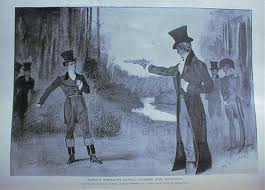
On this day in 1804, two men who had been a critical part of the founding of the U.S. met to settle an old argument.  


Those who knew the two men knew that the conflict was inevitable.  Yet on paper they were more likely to have been comrades than combatants.  In fact, during the Revolutionary War, one of them had ridden through rain and darkness, penetrating British lines to save his entrapped and brilliant comrade.

Yet after the country was founded, these two clever, powerful men found themselves constant competitors.  The competition probably reached its high point in the presidential election of 1800.  The vote resulted in a tie.  Both contenders, Jefferson and Aaron Burr were founders of the same political party.  So the power to choose who would be president rested with the founder of the opposition Federalist Party - one Alexander Hamilton.  He would pick the next president. 


Hamilton had lectured and written about the dangers of the populist attitudes of his former cabinet adversary, Jefferson.  But he feared more the political savvy of Aaron Burr, a man more his ideological equal. So he threw the election to Jefferson, assuming that Jefferson's "folly" as president would later leave the game open to Hamilton. Thus, the brilliant Burr decided to seek revenge on the genius Hamilton (with both assuming that the Renaissance man, Jefferson would shoot himself in the political foot shortly). 


After almost four years of nearly constant bickering Burr challenged Hamilton to a duel on the banks of the Hudson River in Weehawken, N.J.  Hamilton's seconds failed to account for the midsummer reflection of the morning sun off the river.  So, badly positioned and blinded by sunlight, Hamilton was mortally wounded by the man who once saved his life by riding through the rain. 


The U.S. banking system and New Jersey real estate values have never fully recovered. To celebrate go over to a pub in Lincoln Harbor (that's in Weehawken, if you failed geography) for a couple of shots. 


More interesting facts about this duel can be found in our earlier article, Republicrats. 

Many thanks to Mr. Cashin and UBS Financial Services who graciously allow his historical musings to be republished on this site. To enjoy more of Art's posts simply click on "Cashin's Comments" in the label section on the sidebar.

Monday, July 2

President Garfield's Health-Care Experience


By Art Cashin

On this day in 1881, a government worker was hurrying through the Washington railway station hoping to catch a train that would take him to a July 4th holiday with his family on the Jersey shore.  Halfway through the waiting room he was struck by 2 bullets. 


His name was James Garfield and he happened to be President of the U.S.  (Some feel he may have been one of the most brilliant men ever elected to that office.  He could write Greek with his left hand and simultaneously write Latin with his right while holding a normal conversation.) 


The man who fired the shots this Saturday morning was a disappointed office-seeker named Charles Guiteau.  He had hoped to become consul-general in Paris.  Guiteau was probably board certifiable.  He claimed to speak to God and was a member of the radical "free love" movement.  He said he wrote the speech that had elected Garfield - yet no one, not even Guiteau had ever delivered the speech. Garfield, who had hoped to reform the spoils system, interviewed Guiteau shortly after the inauguration in 1881.  Sensing that this was a guy who heard voices without a Walkman, Garfield sent him to the State Dept.  No dopes at the time, the State Dept. sent him back to the White House.  For the next 2 months these two arms of government played appointment ping-pong with Guiteau.  This lasted 2 months until Guiteau received a heavenly message to "kill Garfield." 


Thus, Garfield found himself shot in the shoulder and the lower-back (median right).  Guiteau was arrested leaving the Potomac and Baltimore R.R. Station.  He was trying to get into a cab which he had arranged to take him to the authorities (and keep him from the irate mobs - there were actually only 4 elderly women, a bootblack, a fruit stand operator and, of course, the Secretary of State.......er and of course the Secretary of War - Robert Todd Lincoln - who has the unique record of having been present at every Presidential Assassination in American history except JFK.)  (P.S. He’s buried next to JFK at Arlington.) 


Garfield believed he was doomed and told the doctors "thank you!  But I am dead."  He may have been the President but they knew he was no doctor.  So for the next 2 months, doctors alternated one kind of surgery to find the bullet (unsuccessful) with another kind of surgery to calm infections caused by the former surgery.  After weeks of such care they managed to give him toxic blood poisoning and a temperature of 109.4. Not wanting to tie up the skills of these  important physicians any further Garfield reverted to his original estimate and "died." 

To mark the occasion explain to "she who must be obeyed" that it is not drinking the "see-throughs" that makes one sick - it's all that poking about for the olives. 


Many thanks to Mr. Cashin and UBS Financial Services who graciously allow his historical musings to be republished on this site. To enjoy more of Art's posts simply click on "Cashin's Comments" in the label section on the sidebar.


Thursday, June 14

Tippecanoe and the Tyler Two

Harrison Tyler and his Presidential granddad
By Grant Davies

On this day in 1790, the tenth President of the US, John Tyler, was born. (Actually, it wasn't on this day at all;  the real date was March 29th, but I needed a segue into the story, so I made that part up.)

But this story has very little to do with Tyler anyway, and everything to do with how quickly time passes. It's about how events that happened so very long ago are really more recent than we perceive.

Time flies when you're having kids, and John knew quite a bit about how to make that happen. He had fifteen of them. And he was living proof that "the little blue pill" isn't necessary for everyone who desires to procreate at an age when lots of people in modern times are renewing their AARP cards.

John didn't need pills or cards; all he needed was a wife thirty years younger than him and the inclination to keep up with her. His first marriage lasted twenty-nine years and only ended when his wife, Letitia, passed away after suffering her second stroke. They had eight children, so the stroke isn't a total shock. It could just as well have been exhaustion.

Pretty soon John got lonely, and after about a year and a half, he married again. The second marriage was to a girl in her twenties, Julia Gardiner, who didn't waste too much time before she began turning out little Tylers apace. Her efforts almost tied the first Mrs. Tyler's record, but she came up one short at only seven. It may have saved her life. (That eighth one is a killer.)

Anyway, to cut to the chase, one of her last children was Lyon Gardiner Tyler, and he must have inherited the old man's lust (and endurance), because he fathered a few kids himself at an advanced age. Lyon was born in 1853, fathered Lyon Gardiner Tyler Jr. in 1924, and then Harrison Ruffin Tyler in 1928. By my calculations, that makes him 75 years old when he last had a reproductive evening.

Those last two guys are still alive, and by all recent reports they have all the marbles they started with. They are active, fairly non-political, and give a pretty decent interview. And Harrison - presumably named after the President who died and left his granddad to be the first VP ever to ascend to the top - even retains his sense of humor about the proclivities of his family.

In 2004, statues of his great-grandfather (a Governor of Virginia who used to kick back with a buddy named Tom Jefferson), his grandfather (the 10th President of the US), and his father (the President of the College of William and Mary) were dedicated in a new garden on the campus of William and Mary. After the dedication ceremony he decided to take a stroll in the garden which had just been named to honor his family.

During his walk he came across two students near the statues who seemed to be having a "feel" for history. Pointing to the busts, he told them, "That's my father, that's my grandfather, and that's my great-grandfather, and they could not be any happier about what you all are using this for."

So the next time you hear someone at your local watering hole saying, "I know a guy who knew a guy, who blah, blah, blah", you might remember these two guys, who might actually say in all truthfulness, "my granddad was born in 1790. Whadda ya mean you don't believe me? Well try this, he was the President of the United States too!"

Wednesday, May 30

Charlie Dissed Andy

Image- Garland County library
By Grant Davies

On this day in 1806, a guy named Charlie Dickinson, a Tennessee lawyer, was shot to death. Normally, in a violent world like ours, such an incident would hardly go down in history. But this killing is notable because of the identity of the killer, instead of the killee. (When talking about lawyers it's best to use legal terms.)

Charles Dickinson was a former law student of Chief Justice of the Supreme Court John Marshall who also made formal recommendations and introductions for him. His legal pedigree was only outshone by his legendary reputation as an expert marksman. He was also a guy with a big mouth and it ended up getting him a bullet in the chest after he shot it off more often than his pistol.

The main target for his verbal ammunition was a certain former Tennessee militia leader named Andy who had a run-in over a horse race bet with Charlie's father-in-law. It seems that the horse that his wife's daddy was running came up lame at the post, and according to the agreement he made, he owed $800 to Andy because of it.

Anyway, friends of friends got involved, called each other names and the whole thing led to Charlie putting an ad in the paper calling Andy a "worthless scoundrel, a poltroon and a coward." The scoundrel and coward parts were bad enough, but "poltroon" sealed the deal. No one I know would stand for that.

For those of you who seldom get called names from the 19th century, it's synonymous for sissy. Today that might be included as a desirable trait in a "men seeking men" ad, but Andy didn't go that way, so he was righteously indignant and decided to propose a duel with Charlie. (A duel in 1806 was like a cowboy era showdown, minus the quick draw. Basically you just stand there like idiots and fire at each other).

It didn't help that Charlie had also insulted Andy's wife by pointing out that due to a legal technicality in her previous divorce paperwork, she was a bigamist. What a mess.

During a personal confrontation Andy had called him on it. But Charlie got a little weak-kneed at that meeting, mumbled something about not remembering saying it and asked forgiveness. "If I said that, I must have been drunk. Yeah, that's it, I was drunk." It's a tried and true excuse, and it worked. Andy accepted the apology, but when the ad calling him a sissy appeared in the local newspaper, he lost his sense of humor entirely.

Being law abiding citizens, they met in Logan, Kentucky to try and shoot each other because it was illegal in Tennessee. You sure don't want to break any laws when you blow a hole in someone's chest.

Charlie shot first, but his aim wasn't as good as advertised because he only wounded Andy, who then took his time, took dead aim, and Charles Dickinson passed into history. A number of years later, Andy took careful aim at an important position of power in this country and hit that target as well.

The shooter was none other than Andrew Jackson, lucky number seven on your list of Presidents of the United States. Today, a lot of native Americans probably still use Jackson's picture on the twenty dollar bill as a target, and who could blame them? But that's a story for a different day in history.

Tuesday, April 17

Don't Shoot Willie, We're Republicans!

image - Wikipedia
Editor's note:
For a long time this particular story has been quite popular with readers in South Korea. We have no idea why. If someone could please clue us in to the answer to this enigma we would be grateful. Please leave a message in the comment section after the story. Thanks!


By Grant Davies

On this day in 1945, the Battle of Okinawa, code-named "Operation Iceberg", was raging in the Pacific Ocean. One of the ships participating in the largest amphibious operation of the Pacific War was a destroyer named the USS William D Porter. She acquitted herself well in the battle, firing over 8500 shells and downing five enemy aircraft. But this story is about all the other things that happened in the history of the ship that came to be known as the "Willie Dee."

You see, the ship made quite a lot of history before being sunk by  enemy aircraft, from below the ocean surface. (Huh? more on that later) But it's the history she didn't make that is of such interest.

It was in November 1943, the Willie Dee was an escort ship in a convoy that included the massive USS Iowa battleship which was carrying President Franklin D Roosevelt and the joint chiefs of staff. They were on the way to meet with US allies at Tehran. The President decided he wanted to see the ships in action and called for some exercises to be held. Weather balloons were released for target practice and the guns were fired for the President's amusement.

During the fun, the Captain of the Willie Dee decided to get involved and his hapless crew ended up accidentally firing a live torpedo at the Iowa. Luckily for everyone involved, even though the warnings from the ship were garbled beyond belief, the Iowa was able to make an evasive maneuver and the explosion took place 3000 yards behind the Iowa. So the President didn't die and the wrong kind of history didn't get made.

The Captain and entire crew of the Willie Dee were put under arrest and were lucky that the Iowa didn't blow them out of the water immediately. They actually had their main guns aimed at Willie for a time in case the ship was trying to assassinate the President. You just can't be too careful ya' know!

In retrospect, the whole fiasco was sort of predictable given that the ship had already: crashed into another destroyer while backing out of its slip, lost a sailor overboard when hit by a rogue wave, and accidentally dropped a live depth charge into the ocean, where it exploded, setting the entire convoy off on a wild goose chase hunting for enemy submarines.

Later, on duty in the Aleutian Islands, the ship fired a five inch shell into the front yard of the base commander, which destroyed his garden. After another incident, where she riddled the sides of her sister ship (The USS Luce) with gunfire, she was often hailed by other ships as she entered harbor with the radio message, "Don't shoot, we're Republicans!"

In the end, on June 10th, 1945, she was sent to the bottom by the explosion of a fully loaded kamikaze bomber which somehow ended up directly beneath her after hitting the water, perhaps after her gunners shot it out of the air. If in fact that was the case, in effect, she sank herself.

It's not all bad news though, not a single sailor was lost when she sank three hours after the explosion and only twelve minutes after the "abandon ship" order was given. So there is something to celebrate about the whole story after all.


Today we make a little history of our own here. It's our first ever "15 Seconds of Fame" award, which goes to regular reader Capt. Kevin McCann, USMC (Ret), who sent the idea for this story in along with the excellent article describing the events. Most of the information in that story, along with info from several websites, was the source of the facts found in this post. So here's a tip of the hat, or perhaps a salute instead, to "Cappy" for recommending it.
Related Posts Plugin for WordPress, Blogger...