Showing posts with label Inventions. Show all posts

Thursday, November 19

The Most Expensive Pizza Ever Eaten


By Grant Davies

The year was 2010. A man in Florida, USA ordered two pizzas from Papa John's Pizza. 

It's hard to say why anyone would do such a thing. But this history story isn't about cardboard pizza, it's about what someone is willing to pay to get it. All I can say is they must be pretty hungry and have no other options. There's no accounting for taste, or lack thereof, I guess.

The year 2010 seems like a long time ago to many folks. But then again, anything that happened before 2020 seems like ancient history now.

The two participants in this pizza transaction decided that for this order they didn't want to use US dollars to settle the trade. Who can blame them? Because...

Some people at the US treasury have a special printing press and they just plug it in whenever they need some money to buy stuff, like votes for instance. So the value of the dollar keeps falling because they print so many of them. The value has been falling pretty steadily since 1913. That's when the government invented the Federal Reserve out of the same thin air as the money is printed. The idea was to stabilize the value of the money, they said. Since then the value has declined by about 95%, so I have a suspicion that stabilization wasn't the actual purpose. But then, cynicism about such notions may be forgiven. 

Anyway, the pizza transactors decided to use a different kind of money. They agreed to use some money called Bit Coin. It may have seemed an odd choice to some. But it made sense to them and it didn't seem to be anyone else's business. (Some government types may disagree about that to this very day.)

Between the two of them they had to agree to the value of the Bit Coin so a fair trade could be made. They settled on 10 thousand bit coins for the two pizzas, which would normally sell for about $30 US dollars in those days. It's cheaper nowadays due to the lack of success by the FED at defending the dollar, but again, I digress. Unlike the US dollar some money appreciates in value from time to time. Bit Coin is one of those. 

In those 10 years the price of pizza has declined as well as the US dollar. But Bit Coin is worth a lot more dollars and a lot more pizza by comparison. If the guy who ate the pizza could have just held off his hunger for those 10 years he could have bought more pizza. 

$178 million worth as of this exact moment in time, November 19th, 2020 at 7:30 am.

It's not known if the Papa John's franchise owner still has the bitcoin from that transaction. But if he does I'm guessing he isn't flinging pies into thin air anymore.

To celebrate this story, get on the phone and order a couple of pizzas but be sure to ask if there is a coupon you can use to lower the price. Or maybe a discount for paying with Bit Coin?


PS.  It has been claimed that, with the exception of 4 days in 2017, anyone who has ever bought Bit Coins on any day since it was invented about 10 years ago (and still has them) has a paper profit. Well, a crypto profit anyway.


Editors update: 

Since the date of this article the price of pizza as measured in Bit Coin has risen a tad. On Nov 19th, 2020, the pizza cost $178 million. Today, Jan 8, 2021 at 2:00 pm the price has risen to $400 million. You'd better like pizza a lot.


Thursday, April 30

A Hedy Invention

Editors note:
On this day in history (yes, this very day) we have a story from guest writer James Hinton, a history buff who knows some cool things about various subjects. He has previously been published on "Hankering for History" as well as his own site. We are happy to publish his submission about a largely unknown aspect of the life of one of most beautiful movie stars in history. Instead of frequently hopping from bed to bed as many sex symbols do, she invented "frequency hopping." Brains and beauty, what a concept.
Grant Davies

By James Hinton

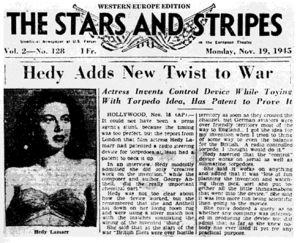
Cheeky Austrian Hedy Lamarr was a hit when MGM imported her iconic good looks and put them up on the silver screen. She starred as a seductive femme fatale alongside of actors like Clark Gable, James Stewart, and Spencer Tracy. Despite being tasked to sell war bonds, she made fourteen movies during WWII alone. What many people don’t realize is that movies aren't the only things Lamarr made during WWII.

Originally married to a fascist munitions manufacturer, the Jewish born, Catholic raised Lamarr had accompanied her husband to many meetings, learning the ins and outs of weapons manufacturing. Infuriated by German submarine attacks on passenger liners, she put her brilliant mind to work coming up with a solution.

Working alongside of composer George Antheil, Lamarr focused on inventing a means by which torpedoes could be controlled by radio. Such control had been attempted before, but always ran afoul of the same problem time and time again. Any signals controlling the torpedo could be jammed by the enemy. Lamarr’s solution was to rapidly cycle through multiple frequencies in a pattern stored aboard both the torpedo and the ship.

“Frequency hopping” was patented in August of 1942, with plenty of time for it to be adopted and put to use hunting German and Japanese ships. Unfortunately, the U.S. Navy, notoriously sensitive about the poor performance of its current torpedoes, refused to adopt the technology until the 1960s.
The technology did not languish, however. Starting with walkie-talkies, frequency hopping began to see use in radios, simultaneously securing communications against eavesdropping and against multiple conversations talking over one another using the same frequency. These techniques would eventually be adapted for computer communication, resulting in the Wi-Fi and Bluetooth technologies that are key to today’s digital revolution.

Hedy Lamarr passed away in 2000 at the age of 85. She was memorialized as a world-famous actress and sex symbol. As important as her contribution was to film, it is today's cell phones and wireless networks, however, that are her strongest legacy.

Thursday, December 18

Chew on This Story

image = chewing gum facts
By Art Cashin

On this day in 1869, Wm. Semple of Ohio was granted a patent on a form of chewing gum. Americans had long chewed a variation of an old Indian substance - - a combination of sap and paraffin. But like many American invention, somewhere else another guy was working on the same project. In this case the somewhere else was Staten Island.

A guy named Santa Ana, who had a somewhat brief political and military career in Mexico (see “Alamo”), was trying to start a new career in his 70's. And, where is a trendier, more intellectually challenging place than Staten Island. He was hoping to produce a substitute for rubber and had brought along some chicle (itself the sap of a Mexican plant).

He showed it to a local inventor, Tom Adams, this particular sample. But try as he could Adams couldn't make a rubber substitute. So one day while he was hanging out at a drug store (the mall had not been invented yet), Adams heard a kid complain about the paraffin gum. Adams went home, soaked some chicle in licorice and kneaded it into little pellets. The druggist sold out the new sample in six hours. Shortly, America was hooked on "Adams N.Y. Gum No. 1".

To mark the day, try not to chew out an employee. Some can be very snappy. And try not to laugh when someone tells you they always thought "Chicklets" was inspired by a poultry symbol.


Many thanks to Mr. Cashin and UBS Financial Services who graciously allow his historical musings to be republished on this site. To enjoy more of Art's posts simply click on "Cashin's Comments" in the label section on the sidebar.

Friday, October 31

Happy Samhain

Image = Lightgrid
By Art Cashin

On this day in (approx.) 823 B.C., the most inventive, charming and clever people ever to grace God's green earth came up with yet another ingenious idea.

They were, of course, the Irish (at this time A/K/A the Celts). Being bright they did not labor upon the obvious. So they let somebody else invent fire, the wheel, iron, astronomy, writing, calendars, etc. These they figured they could copy - - and boy did they. These clever folks....well.....they tended to save their strength for what was really important.

By this stratagem, even 1000 years earlier, while pagan types were grappling with such mediocrity as pyramids, irrigation and geometry, the Celts had learned to distill grain. This miracle medicinal cure (which would maintain mankind for over 3000 years) they called Usquebah. The amazed and very
indebted rest of the world mistranslated the name as "whiskey".

So for a millennia these wise and whiskey-witty folk enjoyed good health and good fellowship. Then as this particular day approached (circa 823 B.C.), gender problems arose. The women began expecting the men to hang out close to the cave as the evening came earlier each fall. If civilization were to progress, this would never do!

So the Celtic elders came up with the second great invention. They called it "Samhain" or end of summer. They explained to the women that as the season changed, ghosts, goblins and evil spirits came forth to threaten all humans. In order to protect the women and children, the men folk selflessly would have to put on old clothes, take some jugs of the magic Usquebah (possible snake bite you know) and go into the hills and light fires.

For nearly 1500 years the tradition held. Then came the good St. Patrick who was wise enough to keep the Usquebah but drove out the snakes. Conveniently, his Christian teaching did say that November 1st was the Feast of All Saints (or "All Hallows"). So it only seemed logical that if the saints were coming out, the devils would have one last fling. So, snakes or not, we would
still need those reliable old clothes, bonfires and protective booze on the eve of "All Hallows" or Hallow's Evening or Halloween.

To celebrate stop by "The Bog on the Moor" and fortify yourself against snakebite, but quit before ye begin to see the little people. For to go beyond, will surround ye with all kinds of devilment like - banshees and ghoulies and mothers-in-law.


Many thanks to Mr. Cashin and UBS Financial Services who graciously allow his historical musings to be republished on this site. To enjoy more of Art's posts simply click on "Cashin's Comments" in the label section on the sidebar.

Thursday, September 18

It's Not Such a Crappy Idea After All

By Art Cashin

On this day in 1908, yet one more American threw aside the doubts of the establishment to start his own company.

Earlier, he had sought financing from America's premier merchant banks. But his enthusiasm was such that they laughed him out of their offices.

Some historians would later guess that it was his name that did him in. Not his first name -- that was a solid sounding William. And even his waspy prospective bankers couldn't object to his last name -- Durant (solid, American). But some felt his insistence on presenting his middle name made the bankers uneasy. For some reason, he insisted on announcing himself, both in person and on his business cards as William Crapo Durant.

Put money on a guy named "Crapo" -- not on your Newport estate. So supposed savvy bankers denied his request for four million dollars. Historical defenders of the bankers claim that it was not his name, but his proposed partners that turned them off. Even if automobiles were good, why would Durant think that combining his Buick operation with Ransom Olds, Maxwell Motors, and Henry Ford could result in a viable business?

So on this day in 1908, Wm C. Durant filed in the state of N.J. to incorporate something called General Motors at a cost of $2,000. (Ford opted out thinking his new Model T was worth more.) In a few short years, Durant dogged by some bankers, had to give up his company to other bankers.

But he then bought a small company called Chevrolet and soon was running GM again. Durant as you may have guessed was not a corporate guy and eventually gambled away over 120 million bucks (equivalent to five billion today).

When he died in the late 1940's, he was telling anyone who would listen that American's next fad would be -- bowling. Some guys just die too early.


Many thanks to Mr. Cashin and UBS Financial Services who graciously allow his historical musings to be republished on this site. To enjoy more of Art's posts simply click on "Cashin's Comments" in the label section on the sidebar.

Monday, July 14

Tired of the Hot Air? Have a Double Dr. Gorrie, On the Rocks of Course!

image = mosi.org
By Art Cashin

On this day in 1850, a doctor at the "Mansion House" in Apalachicola, Florida amazed some guests whom he had invited by serving them drinks with ice. They were amazed not because it was a dry town…..it was
not....the guests were amazed because this was Apalachicola, this was Florida, this was July…..yet here was ice. How deep could his icehouse go…..how many feet of sawdust had he needed to pile up to save these few cubes of ice?

Then the doctor (Dr. John Gorrie) further amazed his guests by bringing more ice…..he brought out whole brick-like blocks of it. The guests were stunned. How had he managed to save this much ice…..in Florida…..into July! Dr. Gorrie laughed and told them he had made the ice only yesterday. "Sure!”
they said. "You made ice in July?" "Who the hell are you…..Mother Nature with a bad calendar watch?"

Dr. Gorrie must have laughed again and told them he had found a way of compressing water and then air in a way to chill things enough to produce ice. "Wow!" said the guests "Now you can open a bar!" Dr. Gorrie looked at them strangely….."Bar?…..This is a cure for malaria!"

Dr. Gorrie had noticed that malaria (a big problem in 1850) seemed to happen near wetlands (like Apalachicola) when it was warm. So he determined it must be the hot air that caused malaria. So, if you cooled the hot air down…..you should be able to stop malaria. That night Gorrie raised enough funds to install his ice-making, anti-malaria machine at the United States Marine Hospital. The main effect was that the rooms were cooler and the patients were cooler but the "yellow fever" continued. (It would be a half century later until Walter Reed would prove that the cause was mosquitoes who thrived in the hot weather…..not the weather itself.)

Although Dr. Gorrie was disappointed at what he saw as his "failure", bartenders and patrons did find a medicinal use for the ice. To celebrate…..call Clarence Birdseye and point out how one man's failure can
be another man's fortune. Forgive the frosty response.


Many thanks to Mr. Cashin and UBS Financial Services who graciously allow his historical musings to be republished on this site. To enjoy more of Art's posts simply click on "Cashin's Comments" in the label section on the sidebar.

Tuesday, April 15

Another Hamburger Joint? What a Kroc!

image = google images
By Art Cashin

On this day in 1955, in the city of Des Plaines, Illinois, a great American institution began. And, like most successful American institutions it made no sense on paper and was started by the illogical. It was a fast food restaurant.

It was not started by some hotshot kid but, rather, by a 55-year-old guy who previously sold blenders for making milkshakes. The year before, on one of his sales trips to California he noticed a drive-in that was doing more business than any other. He itemized its features, it was clean, service was fast, food was uniform. And the fries....they were like nobody else's.

That's when he discovered that they always left on a tiny bit of potato skin in each batch so that the flavor transferred in the frying. Knowing that you probably could not start a nationwide chain of "French Fry Joints" he asked the owners, a certain couple of brothers named McDonald, if he could possibly franchise their fast food hamburger joint.

His name was Ray Kroc and the rest is history. Luckily, he didn't have to apply to the SBA. (Yeah! Sure, Mr. Kroc, just what this country needs, another hamburger joint. How ya gonna make any money. Ain't-cha got any sense of business??)


Many thanks to Mr. Cashin and UBS Financial Services who graciously allow his historical musings to be republished on this site. To enjoy more of Art's posts simply click on "Cashin's Comments" in the label section on the sidebar.

Friday, April 11

The Magic Ingredient

Image = jalopnic.com
By Art Cashin

On this day in 1916, a self-styled genius demonstrated a miracle product to a major corporate entity. The product was so deliciously fascinating that its concept lives today. Any tabloid will tell you that it's really true and that corporate America found it and suppressed it.

The product was that mysterious ingredient that you pop in a tank of water and it can run an automobile. And through all these years the "big guys" kept it hidden. Where were "60 Minutes" and "Geraldo" when we really needed them?

Well, anyway, on this day in 1916, the developer showed this particular hot-shot corporate type how you take said bucket of water, add said mysterious ingredient, pour into said gas tank and run said car. The corporate type was amazed. His name was Henry Ford and he gave the entrepreneur - one Louis Enricht a binder of a year's salary and a free Model T to work on. A few months later Ford read that Enricht had sold the rights (for several years' salary) to another guy. Trying not to be a bad sport - Ford asked for his Model T back. Enricht sent it back without the motor. Rumors said that Enricht had refused to let his new investors examine test engines either.

Scientists now believe that Enricht's magic ingredient was a form of acetone - which would make your engine run while burning it out at the same time. Enricht disappeared but the rumor of a magic pill for the gas tank has hung on through several wars and a few energy crises.


Many thanks to Mr. Cashin and UBS Financial Services who graciously allow his historical musings to be republished on this site. To enjoy more of Art's posts simply click on "Cashin's Comments" in the label section on the sidebar.

Thursday, April 3

The Pony Express - A Risky Business

By Art Cashin

On this day in 1860, a group of entrepreneurs launched their dream. And what a dream it was! They were in the telecommunications business. The nation was suddenly bi-coastal. At both oceans America was thriving. And these guys knew that communications was the key to the future

So, on this day, the first Pony Express rider left St. Joseph, Mo. on his leg of the 1966 mile route to Sacramento California. The cost was $5 per 1/2 ounce (it was later cut to a buck). Ten days later the mail arrived in the Golden State (to the amazement of nearly everyone).

They promoted the service well-very well. The image of a rider fighting off storms, Indians and various animals while rushing your mail was an instant hit. It was a depiction of pioneer life like none before or after. America bought it then and bought it now. The Pony Express thrives to this day in image and movie retelling as the epitome of American survival. Even their recruiting posters smacked of the romance and risk inherent in the endeavor. One example read: "Wanted: Young, skinny, wiry fellows not over 18. Must be expert riders willing to risk death daily. Orphans preferred."

Unfortunately, while it sold as an image, it failed to sell as a service. While the image has lasted nearly a century and a half as a national standard the company lasted only 18 months as a business. Even though the Pony Express used tried and true methods that had been used by Ben Franklin almost 100 years before (and by Darius of Persia nearly 2,000 years before that), the situation failed. What they missed in their calculations was something called the telegraph. So in less than 18 months they were out of business.

To celebrate invite someone who doesn't look like Ben Franklin to play "Pony Express" - - It's a lot like Post Office only there's more horsing around.


Many thanks to Mr. Cashin and UBS Financial Services who graciously allow his historical musings to be republished on this site. To enjoy more of Art's posts simply click on "Cashin's Comments" in the label section on the sidebar.

Monday, November 4

Old 16 and the Vanderbilt Cup

image = supercars.net 
By Grant Davies

On this day (-2) in 1902, a new offering from a fairly well-known automobile company hit the road for the first time. It was billed as the "best built car in America", and it probably was.

The company was named Locomobile and on that day they sold their first four cylinder, gas powered car, the "Model C." It put out an incredible 12 horsepower. If you were looking for enough torque to make your head snap backwards upon sudden acceleration, and the horsepower didn't deliver, the $4000 price tag surely would. (For those who have a curiosity about how much the Federal Reserve has defended the value of the currency since then, that's $120,040.66 in 2013 dollars. But I digress.)

Anyway, some rich guy in New York was loco enough and had the equivalent of a hundred and twenty grand lying around, so he popped for the Model C. The company was off to the races, literally. More on that later.

The Locomobile Company of America had been around since way back in 1899 (that's three years for you lucky kids of the 60s "new math" programs) and had been producing high quality steam powered cars for folks who just wanted to get around town and weren't in a hurry.

According to History.com, "Steam cars had to warm up (literally: the water needed to boil in order to build up steam pressure) for about a half-hour before the car could be driven, and their water tanks needed to be refilled every 20 minutes or so. They also needed three kinds of fuel: water for the boiler, kerosene to heat the water and gasoline for the pilot light." And that's not counting the acetylene that was needed for the car's "key" which was an acetylene torch to light the pilot. The cars weren't exactly racing material.

So when the company decided that the internal combustion engine was the future instead of steam, they hired a guy named Andrew Riker to design the Model C. It lived up to its billing as a well built car and by 1906 he had manufactured one that lasted well enough to win the "Vanderbilt Cup" two years later. The race was an 11-lap, 258.5-mile test, held on Long Island. It was a very big deal back then.

This car, nicknamed "Old 16," was a tad more powerful than the Model C. It had four-cylinders as well but it put out 10 times the horsepower of the Model C. It was a real speedster that looked fast before it was even running. The car is pictured above and there is a really cool video featuring Paul Newman talking about it below. For more detailed and really cool pictures check this page.

To celebrate the day, take the person riding shotgun in your car to the "Old Sixteen Cafe." When the waitress asks you how you want your coffee, just say, "In my cup." You can skip the Vanderbilt part.


Tuesday, July 9

If I Had a Doughnut I'd Give You the Hole

 Image= Camden Public Library
By Art Cashin

On this day in 1872, a man from Maine was given a patent (#128,783 if you must know) on a device to standardize and automate the production of a unique food product invented by another Maine man (25 years earlier). The automation allowed the product to become so successful that today well over billions of dollars worth are sold in the U.S. each year.

The man who was awarded the patent was a guy named John F. Blondel of Thomaston, ME, and he was a fine guy indeed. But the real genius was the earlier guy....a certain Hanson Crockett Gregory born in Clam Cove, Maine (no smart aleck...that's not where Jessica Fletcher lives).

Anyway...Hanson Gregory would have eventually been famous even without his discovery. He was such a good sailor; he captained a cargo ship before his 19th birthday. By age 20, that he had conducted such heroic sea rescues in violent storm-tossed seas that he was given an award by Queen Isabella of Spain. And his sea exploits continued until he died in 1921 at ago 90.

But history (or at least historians) chose to best remember Hanson Gregory not for what he did at sea but rather for what he did in the kitchen (at age 15 no less). Back in the year 1847, Hanson Gregory invented the doughnut...(Okay! Okay! Hold it down! I know what you're thinking..."I read this dope everyday and now he's trying to tell me some guy in 1847 invented doughnuts when I know that doughnuts are over 3000 years old....in fact I had a 2000 year old doughnut last Thursday.")

While you're wrong about how long doughnuts have been around (it's more like 500 years), I will concede Gregory didn't invent the doughnut...he invented the hole in the doughnut. Yup, the hole! Prior to Hanson Gregory, doughnuts were dough - nuts (often walnut sized lumps of sugar dough fried in oil...have you ever had a Zeppole for St. Joseph's Day?).

Anyway, young Hanson is sitting in the kitchen at age 15 and says to mom..."Gee the middle of the doughnut never seems to cook right!" So he cuts the doughy part out of the center with a fork. So mom says a mom thing like..."What am I supposed to do....throw the middle away all the time just because you think it's not cooked!" Then young Gregory says a smart-ass kid thing like..."No ma! You cut the middle out before
you cook it" and then he takes the fork and cuts a hole in the middle of the dough.

The rest is history.....and dollar signs.


Many thanks to Mr. Cashin and UBS Financial Services who graciously allow his historical musings to be republished on this site. To enjoy more of Art's posts simply click on "Cashin's Comments" in the label section on the sidebar.

Friday, May 31

Henry Wells' Joyride

Image = eyewitness to History
By Art Cashin

On this day in 1896, a man named Henry Wells of Springfield, Mass. decided to show the folks of New York City just what a clever fellow they had the luxury to see among them. (Wells may not have realized that the streets of New York are littered with the bones of folks who proposed to show the same thing.)
Wells left his digs in his new and expensive "Duryea Motor Wagon." (You will recall that the giddy Duryea brothers had invented something called the automobile in an earlier episode.)

Anyway, Wells was powering uptown (balloon horn a' honk) at maybe an amazing 18 MPH. Suddenly in his path was a Ms. Evelyn Thomas, astride her recklessly ridden bicycle. Unfortunately, for Wells there were two Irish cops at that corner. Given a Gaelic sense of justice they determined that right was weight or maybe inversely. (If you're not a Gael perhaps that may seem confusing.)

Nonetheless, the boys figured the car was bigger than the bike and thus it was not a fair fight. So they put Wells in jail overnight and sent Ms. Thomas to Manhattan Hospital to assess her life threatening injuries (a fractured leg).

After shaking Wells loose of some excess weight in his wallet (fines, legal fees, municipal scams), the authorities released him. It is assumed he returned north and lived out his days in one of those burgs where life is played at AAA level.

To celebrate take someone for a joyride. But recall that DWI tests aren't always administered by guys who try to match their cultural heritage with your blood/proof level.


Many thanks to Mr. Cashin and UBS Financial Services who graciously allow his historical musings to be republished on this site. To enjoy more of Art's posts simply click on "Cashin's Comments" in the label section on the sidebar.

Thursday, April 11

A Toast to Walter Hunt

Image = Moah.org

By Art Cashin

On this day (-1)  in 1849, the U.S. Government issued patent #6281, for a very remarkable and stunningly successful product. The product was so simple yet useful that most people think it's been around for centuries.

No smarty, it was not the telephone nor the fax nor even the radio, this product sold ten times as many items as every telephone, fax or radio ever made. Pointedly speaking, short of matches maybe no other product has sold so often or in such volume.

The product is....the safety pin! And its invention was a bartender's delight. In a saloon conversation a customer complained of the problem of fastening things easily without cutting your finger or harming the person wearing what you were fastening. After a couple of rounds, a guy named Walter Hunt opined that the solution to the riddle was not so tough. After calling for a piece of string steel (to the left of the olives and two shelves down from the boiled eggs - - doesn't every saloon have them) he began to twiddle.

Egged on by cynics and buyers of rounds he first resolved a loop at the end to give the gadget spring. But what helped was a spring with two pointed ends. Amidst hecklers and more drink buyers Hunt showed that by hammering one end (with a bartender's muddle); you could cap the sharp end of the pin. Thus in less than three hours Walter Hunt had invented one of the most widely sold items in human history.
                        
But it wasn't over. The cynics at the bar said it would never work. Another round please! But one guy said, "Hunt, I'll pay you $100 for the rights." And Hunt said, "Sold!" Thus in three hours and ten minutes Hunt had conceived invented and then sold the rights to one of the simplest yet most successful inventions in history.

It’s hard to imagine. Whoever heard of a clever guy sitting at a bar giving away million dollar ideas for free?  Pass those peanuts please.


Many thanks to Mr. Cashin and UBS Financial Services who graciously allow his historical musings to be republished on this site. To enjoy more of Art's posts simply click on "Cashin's Comments" in the label section on the sidebar.

Wednesday, March 27

The Straight Story

By Grant Davies

On this day in 1998, a chemical substance of great significance was approved for use in the USA by the FDA, after having been discovered by medical researchers in the UK two years before.  It sailed through the approval process in an extraordinarily short time.

What could this invention accomplish that would be so important that its application shot straight to the top of the list? The question is hard, to say the least, but let's look first at some of the benefits that have been uncovered since that day.

Researchers in Israel and Australia  have found that if the drug is dissolved in a vase of water it can extend the shelf life of cut flowers. It can make them stand up straight for up to a week beyond their natural life span. Amazing! It does that by slowing the breakdown of cGMP-specific phosphodiesterase type 5(cGMP), but you probably already guessed that.

The same process also slows down plant ripening. According to Wikipedia, "Tests were done on strawberries, legumes, roses, carnations, broccoli, and other perishables." Truly a wonder drug.

But that's not all. In 2007, three people in Argentina won the Nobel Prize in Aviation when they discovered that the same stuff aids jet lag recovery in hamsters. This had previously been a huge problem for the many hamsters who fly across multiple time zones. But no more, thanks to this wonder drug.

As impossible as it seems, the drug wasn't initially intended to fix these pressing problems. It seems that millions of men were having problems getting things straight. They had the same problem as the flowers that went limp too soon. The drug fixed that problem and formerly lethargic men became upstanding citizens.

The drug was Sildenafil citrate, more commonly known as Viagra. The people who use it are firm in their support and it became one of the biggest blockbuster drugs of all time.

Tuesday, March 5

The Ice Man Cometh

Image = Todayinsci

By Art Cashin

On this day in 1806, one of the best examples of American capitalism took place. It had it all. A product that could be produced very cheaply. A group of people who could use the product. A clever but inexpensive means to transport the product from where it was made to where people needed it.

On this day in 1806, Fred Tudor arrived in the Caribbean port of Martinique. Tudor had sailed from Boston with a shipload of ice that had been harvested in the dead of winter from his dad's pond. Despite the claims of critics, Tudor made the ice last by insulating it with sawdust and hay (which were naturally to be washed off when the ice was sold).

The first day of Tudor's arrival was a smashing success. People paid high prices for the product he offered. But the next day...that was a problem. They had unloaded all the ice and, the boys at the dock, trying to be helpful, had washed off the insulation. Net result...night two...puddle of water...lots of screaming people offering to pay any price for the ice they now missed. Thus Tudor's ice idea was a failure...but he had
learned two key parts of marketing...keeping a product fresh (storage) and how once you create demand people will pay up in scarcity. He returned to Boston, poorer but wiser.

There he raised new capital and bought the rights to harvest ice from several local ponds. But travel got risky as the War of 1812 broke out. After the war, however, Tudor sent a ship to Havana...not with ice but with thick cedar planking and sawdust...he was going to build an ice-house in Havana to keep the ice fresh. Then he sent some ice to see if the ice-house worked. It did.

He then asked for a 10 year exclusive contract to be the sole supplier of ice to Cuba and Martinique. No one thought it was a big deal since folks were not used to having ice in those locales. Then he started giving the ice away, especially to bartenders (along with exotic frosty drink recipes). The "free ice" created a demand, so then Tudor began charging higher and higher prices (remember the exclusive).

This ingenious marketing concept was later adopted by King Gillette and is commonly called the razor/razorblade theory. (You practically give the razor away and when they need new blades only your blades fit that razor....Op. Cit. "Barbie & Ken dolls.")

Tudor went back to New England bought up the ice rights of hundreds of ponds, commissioned the manufacture of huge ice saws to cut the blocks of ice from the ponds. He compounded the strategy all through the South (one source says he invented the mint julep just to sell more ice).

For 80 years, Tudor and his heirs were the "Ice Kings" of America. All from a product nature supplies for free. And he became a multi-millionaire in the process.


Many thanks to Mr. Cashin and UBS Financial Services who graciously allow his historical musings to be republished on this site. To enjoy more of Art's posts simply click on "Cashin's Comments" in the label section on the sidebar.

Wednesday, February 27

Sam Colt's Invention

Image =Biography.com

By Art Cashin

On this day (-2) in 1836, the government of the United States granted a patent on a device that would become the prototypical American weapon. And, by accident, its development would become a prototypical story of American invention.

The patent, of course, was awarded to Samuel Colt for his "single barrel pistol with a six chamber revolving breech." You and I (as well as Hoppy, Roy and Gene) knew it as a "six shooter." Colt's idea was not entirely unique. Several patents for revolvers had been granted earlier (one of the earliest was for a "12 shooter" but it, like the others, didn't work well). But Colt, who was 22 when he got the patent, showed his gun was practical (and at the time....it was the only way a man on horseback could get several shots off successfully).

Therefore, it seemed like a good idea and Colt found backers who helped him open "The Patent Arms Company" in Paterson, N.J. But despite rave notices for the weapon, sales were slow and the factory closed in 1842. Colt slipped closer to bankruptcy. Then in 1846, fate took another weird turn.

The U.S. was going to war with Mexico. And the Texans they were fighting for, suggested to the American Secretary of War that many of them were very happy with Mr. Colt's six shooter. So the Secretary of War ordered lots of them. That left Mr. Colt with several problems. 1) He had no factory. 2) He didn't have a six-shooter left to his name. He attacked the second one first. He advertised for samples of his own gun. Gun owners thought the ads meant the revolver was now a collector's item…..so they refused to sell. Colt was reduced to hiring a gunsmith to work from Colt's own original diagrams (with suggestions from the famous Texas Ranger - Sam Walker).

Finally.....when they had developed a prototype…..Colt needed to hurry things up. So he hired…..who else.....the son of Eli Whitney to implement the concepts of mass production and interchangeable parts. Within a decade the Colt .44 was the gun that was winning the West.

To celebrate go to some place with a swinging door and order six shots of red eye. And tell the surly looking guy with a facial tic and a mustache (down at the end of the bar), the immortal words of Hopalong Cassidy. "No matter how loud or how fierce the guy behind a rock sounds, if you count the bullets, when he's out of ammunition he's out of luck." Thanks Hoppy!


Many thanks to Mr. Cashin and UBS Financial Services who graciously allow his historical musings to be republished on this site. To enjoy more of Art's posts simply click on "Cashin's Comments" in the label section on the sidebar.

Thursday, January 24

Gottfried Kicked the Bucket

Image courtesy
of Ale House.com
By Grant Davies

On this day in 1935, one of the most important innovations in history was introduced to a test audience. It received a 90% approval rating with that group, and that was enough to set a whole industry humming with its new offering.

The product itself was fairly new, only about 6000 years old, and was still being tested by a lot of people. I still test it myself to this very day. Almost every day.

But it was the method of delivery that was innovative, not the product itself. The product needed an improved method of packaging so it could be delivered more efficiently.

You see, the product was liquid. And before this time it tended to spill during delivery and it didn't keep well after it arrived. First it was carried in small buckets, and later it was packaged in glass bottles.

The bottles, even though far superior than the pails, had plenty of drawbacks. They were heavy, tended to break easily, and had to be washed out before being re-filled again. They also were expensive as hell and the end user had to pay a deposit on them each time they were purchased.

image courtesy of
Dan Morean's Breweriana.com
So on this day back then, a company named Gottfried Krueger did something no one else had tried; it put its product into a can. Of course various foods had been canned before, but not this most precious of all liquids, beer.

Once the whole brewing industry caught up, and canned beer became commonplace, people could get sloshed in their own homes without worrying that the golden nectar itself would slosh out while their 12 year old sons carried it home from the local gin mill, er..ale house, in a bucket. (Today, they put the bottles inside a bucket and sell them during "happy hour." Progress is a beautiful thing.)

Without this innovation my teen-aged friends and I couldn't have poked a hole in the bottom of a beer can, put it up to our mouths, and simultaneously popped the pull ring on the top so we could drink an entire beer in about 4 seconds. Think of all the fun we would have missed.

I guess you had to be there...


Editors note -- Permission to use the images of the early beer cans was not in time for original publication of the article, but I think they are very rare and quite interesting so they are being added now. The site they were taken from is quite interesting if you like "breweriana." In fact the site can be found at Breweriana.com.

Monday, January 14

A Pie in the Sky Idea


By Art Cashin

On this day (-1) in 1957, the inventive son of a bright inventor and a company with a flair for marketing combined to launch a product that would captivate the youth of America (and elsewhere) for over a third of a century.

The inventive son was Walt Morrison, whose dad had perfected sealed beam headlights.  The company was the Wham-O Corporation, which had found a way to sell slingshots to kids who used to make them for free in their backyards.

Anyway, Morrison noticed that America, after two back to back wars, was captivated by space, aliens and science.  He also noted that America was filled with young soldiers returning to the girls they left  behind and girls grateful to see young men again.  The confluence of events resulted in the greatest decade of attendance at drive-in movies and the greatest outpouring of grade B & C - science fiction movies for said drive-ins.  

Morrison noted that these movies that the people watched in drive-ins (watched during trips to the snackbar) all seemed to have "Flying Saucers" (or what looked like an inverted saucer hung from a string).  So he resolved to develop a toy that would fly through the air looking like one of the saucers.  And when he and Wham-O introduced it this day, naturally they called it - "The Flying Saucer."

Sales were okay for a while but they decided to try a marketing effort on college campuses.  When they hit Yale, they found students playing games of catch with their own version of a flying saucer -- empty pie tins.  When asked what they were doing, they replied "frisbieing" since the original pie tins had come from the Frisbie Baking Company.  The Wham-O folks were smart enough to re-name the product to catch on to an existing East Coast fad.  Thus the "flying Saucer" became the "The Frisbee."


Many thanks to Mr. Cashin and UBS Financial Services who graciously allow his historical musings to be republished on this site. To enjoy more of Art's posts simply click on "Cashin's Comments" in the label section on the sidebar.


Wednesday, December 19

Poor Richard, the Guy had No Talents


Image = American History Now
By Art Cashin

On this day in 1732, a 26-year-old Bostonian transplant, living in Philadelphia published a helpful calendar and counselor, which he called "Poor Richard's Almanac."  The publication, containing pithy wisdoms like - "Early to bed early to rise makes a man healthy, wealthy and wise" - or (Washington, D.C.'s favorite), "A penny saved is a penny earned" - became an instant success in the colonies.

The revenues allowed Benjamin Franklin to retire at age 42.  Since golf was not available in the neighborhood, he squandered his remaining years by discovering electricity, inventing the lightning rod, the iron stove, bifocals and the glass harmonica.  The next week he developed still-standing theories on meteorology, heat absorption, electricity, and ocean currents.

In his spare time he founded the first insurance company, fire department, public hospital, public library, night patrol and  first militia.  Seeking a break he became colonial postmaster and civil defense chief for the French and Indian War.

Tiring, he was chief delegate at the Albany conference, which organized the colonies and then was appointed chief negotiator with the British crown in London. When negotiations failed he returned home to help draft, and then pass the Declaration of Independence.

He was then sent to Paris where he won the support of the French, which event won the Revolution for the colonies.  He returned home and helped draft and again pass the Constitution of the new nation. After that he did little that was important aside from a few inventions and a couple of immortal publications.

To celebrate take a high school graduate out for a flagon of ale and explain the team concept, consensus thinking and why little can be accomplished by one man alone.


Many thanks to Mr. Cashin and UBS Financial Services who graciously allow his historical musings to be republished on this site. To enjoy more of Art's posts simply click on "Cashin's Comments" in the label section on the sidebar.


Tuesday, November 13

He Invented the Car Because They Said He Did

Geo takes a joy ride
Image = Wikipedia
By Grant Davies

On this day, (-8),  in 1895, a man named George Selden  invented the automobile. Well, at least that's what the US government, in its infinite wisdom, decided on this day.

He didn't invent it on this day. In fact he didn't invent it on any day. But the government, through its patent office, decided he did, on this day. It's kind of confusing, but then, patent law can be as confusing as the writing on this site.

Anyway, George was a lawyer so he knew the ins and outs of patent law better than most. He took advantage of that knowledge and gained the legal right to scam a bunch of other people who actually did invent stuff related to automobiles.

According to History.com he won "U.S. Patent No. 549,160 for an "improved road engine" powered by a "liquid-hydrocarbon engine of the compression type." In other words, a car.

He never built one. In fact, for the filing, he just copied the design of one he had seen some years earlier at the 1872 Philadelphia Centennial Exposition. Anything worth admiring is worth stealing I guess.

So a few years later, in 1899, he sold the rights to his "invention" to a group of investors (or criminal co-conspirators, as you wish) who called themselves the "Electric Vehicle Company." They in turn sued a company, the "Winton Motor Carriage Company", the largest car maker at that time, for manufacturing gasoline powered automobiles. It didn't take long for the Winton company to see the value in paying the ransom and they struck a deal with the legal thugs. The courts agreed to the deal and upheld Selden's patent in 1903.

Soon a whole bunch of car companies who wanted to be part of a monopoly CARtel (pun intended) joined in with the parties to that lawsuit and formed the "Association of Licensed Automobile Manufacturers." They then sued anyone who dared to make a car without paying them protection money. (See? I told you it was confusing.)

Later a guy named Henry Ford had a different idea. A few lawsuits and appeals later he put an end to the whole scam.

To celebrate legal extortion and monopolies, find a bar and have a few beers. But don't forget to make a toast to the overpriced brew you are sipping because it's illegal for the bar owner to buy his beer from anyone other than a "legal" distributor. Cheers!
Related Posts Plugin for WordPress, Blogger...