Showing posts with label Grant Davies. Show all posts

Thursday, November 19

The Most Expensive Pizza Ever Eaten


By Grant Davies

The year was 2010. A man in Florida, USA ordered two pizzas from Papa John's Pizza. 

It's hard to say why anyone would do such a thing. But this history story isn't about cardboard pizza, it's about what someone is willing to pay to get it. All I can say is they must be pretty hungry and have no other options. There's no accounting for taste, or lack thereof, I guess.

The year 2010 seems like a long time ago to many folks. But then again, anything that happened before 2020 seems like ancient history now.

The two participants in this pizza transaction decided that for this order they didn't want to use US dollars to settle the trade. Who can blame them? Because...

Some people at the US treasury have a special printing press and they just plug it in whenever they need some money to buy stuff, like votes for instance. So the value of the dollar keeps falling because they print so many of them. The value has been falling pretty steadily since 1913. That's when the government invented the Federal Reserve out of the same thin air as the money is printed. The idea was to stabilize the value of the money, they said. Since then the value has declined by about 95%, so I have a suspicion that stabilization wasn't the actual purpose. But then, cynicism about such notions may be forgiven. 

Anyway, the pizza transactors decided to use a different kind of money. They agreed to use some money called Bit Coin. It may have seemed an odd choice to some. But it made sense to them and it didn't seem to be anyone else's business. (Some government types may disagree about that to this very day.)

Between the two of them they had to agree to the value of the Bit Coin so a fair trade could be made. They settled on 10 thousand bit coins for the two pizzas, which would normally sell for about $30 US dollars in those days. It's cheaper nowadays due to the lack of success by the FED at defending the dollar, but again, I digress. Unlike the US dollar some money appreciates in value from time to time. Bit Coin is one of those. 

In those 10 years the price of pizza has declined as well as the US dollar. But Bit Coin is worth a lot more dollars and a lot more pizza by comparison. If the guy who ate the pizza could have just held off his hunger for those 10 years he could have bought more pizza. 

$178 million worth as of this exact moment in time, November 19th, 2020 at 7:30 am.

It's not known if the Papa John's franchise owner still has the bitcoin from that transaction. But if he does I'm guessing he isn't flinging pies into thin air anymore.

To celebrate this story, get on the phone and order a couple of pizzas but be sure to ask if there is a coupon you can use to lower the price. Or maybe a discount for paying with Bit Coin?


PS.  It has been claimed that, with the exception of 4 days in 2017, anyone who has ever bought Bit Coins on any day since it was invented about 10 years ago (and still has them) has a paper profit. Well, a crypto profit anyway.


Editors update: 

Since the date of this article the price of pizza as measured in Bit Coin has risen a tad. On Nov 19th, 2020, the pizza cost $178 million. Today, Jan 8, 2021 at 2:00 pm the price has risen to $400 million. You'd better like pizza a lot.


Saturday, July 11

History has Been Canceled Until Further Notice


By Grant Davies


On this day in 2020, give or take a few weeks, a small but well organized group of thugs tried to erase all the history of the US.

A majority of the citizens of the country and many of the politicians and elected officials of the country did nothing to stop them. Some even encouraged them.

In the end history will survive even if it's incorrect history. Since most history is incorrect anyway most people will not notice this in a few years.

Even though the history found on this site is probably correct, those thugs have been thus far uninterested in erasing it. I guess they realize that I have several readers instead of millions.

But mainly they were too busy looting and burning to pay attention to it. And many are illiterate so they don't bother if it's like, um, you know, words and stuff. Unless it's a statue of a person they never heard of they just can't be bothered.

But this site is all about having some fun anyway, not portraying serious events like the erasure of history.

I just wonder, are we having fun yet?

Sunday, January 26

Give That Man a Prize

Image = Wikipedia

By Grant Davies

On a day just like this, back about fifty years after the 1880s, perhaps circa 1930-ish, a professor at the University of Lisbon decided to do some science.

Before we move on to the actual story, I think it's best to explain how such a precisely imprecise date was arrived upon. I used a calculator. And I guessed at the figures. The 1880s had some meaning for where to start counting, but I'm probably not going to tell you why, just because.

But who cares anyway? It's not actual history, it's Cheeky History. Exact dates require research I'm loath to do.

Anyway, the guy's name was Egas Moniz and he was a scientist, kind of. A former politician, (a republican, lower case) he was a professor of neurology at the above named University. He formed a hypothesis about where in the brain mental illnesses of various kinds originated and how to treat them. Based on the work of others back in the 1880s he decided it was in the frontal lobe of the brain. (Okay, I guess I slipped and told you about the 1880s part, darn it!) So he decided to see if destroying that part of the brain would cure these illnesses. They called the surgical procedure leucotomy. We know it today by a different name. More on that later.

Unfortunately, his scientific method was anything but scientific. According to Bill Bryson in his new book "The Body" (paraphrased), Moniz had no idea what the outcome might be or what damage might be done to the patient. No experiments were done on animals first and he was pretty careless about which patients he chose. (At least one died in an earlier attempt.) He also didn't follow-up well on what the outcomes were. Additionally, he didn't perform the surgeries himself but was keen to take credit for any that were claimed to be successful.

When scientists do science poorly the outcome usually is apparent to scientists who do science well. That can lead to derision and a loss of stature, not to mention income. But that didn't happen to Egas.

Instead, in 1949, he was awarded, (you guessed it) the Nobel Prize. It was for "his discovery of the therapeutic value of leucotomy in certain psychoses." (Wikipedia)

In other words, some of his patients improved a bit on the mental illness they had. Unfortunately they turned into zombies. Perhaps if he had hit them in the head with a shovel it might have had the same effect. (I'm told that leaves a dull impression on the mind) At least he didn't do that.

I don't want to be too hard on him considering the times he lived in. But if he can get a Nobel Prize for crummy science why can't I get a Pulitzer Prize for crummy writing?

To celebrate all the crazy surgeries performed by the others who followed in his lab coats, just slip on down to the "Weird Science Lounge" and when the bartender asks "what'll you have?"  Just tell him, "I'd rather have a bottle in front of me than a frontal lobotomy."


Inspiration for this story came from Bill Bryson's excellent book, "The Body" - "A Guide for Occupants" 

Wednesday, December 5

Krampus Claus is Coming to Town

By Grant Davies

 On this day, December 6th eve, every year,  Krampus Claus is coming to a town near yours. So you better watch out.

Or as the song has it:

"You better watch out
You better not cry
You better not pout
I'm telling you why


Krampus Claus is coming to town."

Okay, there is no guy called that. I gave Krampus a last name because I wanted to. I write this nonsense, so I can do as I please.

Anyway, Krampus is a real make believe guy. As real as Santa Claus anyway. And he even has a day (okay, a night) named for him. It's called Krampusnacht.  For those of you who failed German class in high school, that translates to Krampus Night.

That's the night this half-goat, half-demon sneaks into town and beats children to a pulp if he determines they have been bad. Or not good, I guess.  Or if they cry or pout. He also seems to lick their head and clean the wax from their ears with his fingers, according to the picture below. And he does this while in chains, so he's pretty competent.

I'll take the beating, thank you.  But that's just me.


What all this tells us is that if the worst thing that happens to you is that you find coal in your stocking or don't get that new I-Phone you have been wanting, just count yourself lucky.

One other thing, I'm pretty sure that if you don't live in Europe somewhere, this doesn't apply to you.

Happy holidays.


PS

We have a new winner of the coveted "15 Seconds of Fame Award." 


It's Matthew Latourette, who gave me the idea to write this post.  He recently was mentioned in the Chicago Tribune by name as well, so he's on a roll. Congrats!
Okay, your time is up.

Monday, May 28

The Amazing Talent of Bob Evans

Bob Evans - Supernovae finder extraordinaire
By Grant Davies


Some people have amazing talents that most of us could never image. Bob Evans is one of those people.

I love sausage. And lots of sausage lovers have heard of Bob Evans in regard to making tasty breakfast sausage. But that's not the same Bob as the Bob in today's story.

Our Bob is a retired Minister. He is semi-famous in some circles in Australia for doing serious research and writing books about the history of evangelical revivals.

Even though this is a history blog (kinda), we don't usually write about historical stuff quite that exciting here. Bob's talent for that endeavor is not the one I'm about to amaze you with.

Bob's hobby is finding Supernovae, and he's really, really good at it. Better than anyone else who has ever tried it, so they say. He finds them by looking through backyard telescopes from the small deck of his house in a town not far outside of Sydney, Australia. Other than his telescope his only other tool seems to be his amazing talent for remembering where all those dots in the sky are and noticing when a new dot appears where there wasn't one before. Just in case you aren't as amazed as I am about Bob's amazing memory of where the dots were,  I'll explain.

According to Bill Bryson in his book "A Short History of Nearly Everything" it's explained this way:

(Paraphrased) "imagine a standard dining room table covered with a black tablecloth and someone throwing a handful of salt across it. Think of the salt grains as a galaxy. Now, imagine 1500 more tables like that, each table with random salt tosses, enough to fill the parking lot at Walmart. Now add one grain of salt to any table and let Bob walk among them. At a glance he will spot it."

Now that is amazing! I betcha you can't do that. I can't even remember if I had Bob Evans sausage for breakfast.

To celebrate Bob's amazing talent, drop down to the Star Gazers Lounge and have the Super-duper Supernova Martini. But if you see Bob there and you introduce yourself, don't expect him to remember your name if you meet him again. He says he's not very good at remembering names and his wife says he can't remember where he's put things.

Amazing.

Wednesday, November 30

History, Music, and Redemption

By Grant Davies

On this day in 2011, I wrote a short commentary as a lead in to a video and posted it to my sister blog What We Think and Why. That blog isn't about history but this blog didn't exist back then. Just about every year since then it pops up on my FaceBook feed again. I always feel compelled to share it again.

Today, on the 5th anniversary of posting it, I will add it to this site because it is about history even though it's not too "cheeky."

Some of you have seen it before. Most of you haven't. If you have, you will probably enjoy watching it again. If not, you are about to learn something about History, Music, and Redemption that you might not have known. I present it here unedited. I hope you enjoy watching the video as much as I enjoy posting it.

History, Music and Redemption


Whether it's good ideas, interesting writing, witty humor, important information or videos which deliver some or all of those things, a great blog post is made from great content. On this site I do my best to deliver those things. Sometimes I even succeed.

I write about and post things that I see, hear or just think about. Things I think are important. Many of them concern ideas about freedom or people and events that somehow connect to freedom issues. Some might say this is a political site, but even though it's hard to escape from politics in these times of tumult, I hope it's more than that.

History is one of my loves. So is music. And like so many others, I'm fascinated by the battle between good and evil. So when all three of those things come together in one place, it's impossible to resist sharing them.

One of my favorite musical pieces is the hymn, Amazing Grace. And the history behind it's creation is an incredible story of good, evil and redemption. It's a story I only learned a few years back, long after I fell in love with the melody and power of the song.

The story of John Newton, who wrote the words, is as inspirational as they come. If you don't know the history, do yourself a favor and follow the link, you won't regret it. His fall from grace and final return to receive it again is classic. But as it now turns out, (and as is often the case) I only knew half the story.

The other half of the story concerns Negro Spirituals, the black keys on the piano, the "slave scales" and the writer of the music itself. Someone known only as "Unknown." I will never listen to the hymn the same way again. For me, it used to be special, now it is delicious.

After watching the video below, I can almost feel the pain and suffering of the groaning victims of slavery and the different kind of pain and ultimate redemption of one of those who perpetrated it upon them.

If you feel it too, then this will be better than the usual post on this blog. I hope it will be a great post because of the great content.


Many thanks to Bobbie Rendleman for posting the video link on Facebook.


Many thanks to Bobbie Rendleman for posting the video link on Facebook.


Thursday, December 31

Our Old Acquaintance, Bob

By Grant Davies

On this night in 1787, people in Scotland got together, lifted a glass, and sang a song. "Big deal" you say! They do that in Ireland every darn night. Come to think of it, if the joint is open long enough, they do that everywhere a glass of intoxicating beverage is to be lifted. So what makes this night special enough to make note of it?

Well, that was the year the above referenced song was first published. The guy who is credited with writing it, Rab Mossgiel, was rather famous among his fellow Scotsmen for writing other poetry. Rab was just his pseudonym. I guess he liked it better than his real name, Bob. More on that in a moment.

Anyway, the guy actually admitted that he didn't compose it himself, but merely wrote it down after hearing it from "an old man." It's pretty certain that the old man didn't write it either.

The poet's actual name was Robert Burns. And it seems the song was initially sung on January 25th - also known as "Burns Night"-  to celebrate his life and works. But it's normally sung to wave goodbye to the old year and welcome in the new, hopefully better, year.

The song has a rather weird title that is translated from old Scottish English into modern English as "Old Long Since." I guess it made more sense back then. The rest of the words are almost as difficult to piece together too. But most people over a certain age (my age) recognize them well enough.

The song asks the question, should we just forget about our old friends? Well, I guess not. So then, shall we raise a glass and toast them and all the good times we have had with them? Hell, yes!

By now you have probably guessed that the song is the well known New Year's Eve standard, Auld Lang Syne. And the "cup of kindness" is some sort of booze that is being used to toast good fellowship and not forgetting our friends no matter what happens in the new year.

To celebrate the song, go down to the "Auld Neighborhood Inn" with some friends and order "a cup of kindness" from the bartender. Just make sure "it comes to mind" to tip him well. After all, a bartender is a man's best friend and definitely should not be forgot.


  Auld Lang Syne

Should auld acquaintance be forgot,
And never brought to mind?
Should auld acquaintance be forgot,
And auld lang syne?

For auld lang syne, my dear,
For auld lang syne,
We'll tak a cup o' kindness yet,
For auld lang syne.

And surely ye'll be your pint-stowp,
And surely I'll be mine!
And we'll tak a cup o' kindness yet,
For auld lang syne.

For auld lang syne, my dear,
For auld lang syne,
We'll tak a cup o' kindness yet,
For auld lang syne.

We twa hae run about the braes,
And pu'd the gowans fine;
But we've wandered mony a weary fit
Sin' auld lang syne.

For auld lang syne, my dear,
For auld lang syne,
We'll tak a cup o' kindness yet,
For auld lang syne.

We twa hae paidled i' the burn,
Frae morning sun till dine;
But seas between us braid hae roared
Sin' auld lang syne.

For auld lang syne, my dear,
For auld lang syne,
We'll tak a cup o' kindness yet,
For auld lang syne.

And there's a hand, my trusty fiere,
And gie's a hand o' thine!
And we'll tak a right guid-willie waught

For auld lang syne.

For auld lang syne, my dear,
For auld lang syne,
We'll tak a cup o' kindness yet,
For auld lang syne.


Most of the information for this post was gleaned from Carols.org.

Saturday, May 16

Lucille and the Blues Boy

image = picshark
By Grant Davies

On this day (-2) one of the most iconic figures of our time passed into history.

This story is about his love affairs. He had many, and they gave him the blues. In fact, he had a love affair with the blues. If none of this makes sense, just stick with me, I'll do my best to further confuse you.

His name was Riley B. King (nickname - The Blues Boy) and the longest affair he had was with his beloved Lucille. He fell in love with her even before she had a name. He actually named her himself. He did so right after he ran into a burning building to save her from the flames. At least that's the legend, and like much of the stuff on this site, it's probably true.

Lucille was named after a girl who, one evening in a dance hall, was the object of admiration of several suitors. So enamored of her were these two men that they took to fighting over her. Such rash behavior rarely ends well and this time was no exception. During the melee a barrel of fuel was knocked over and the resulting conflagration set the stage for Riley's courageous rescue.

He ran into the building, grabbed his guitar, and successfully retreated. Guitar? What about the girl and the combatants? Um,,I don't know. It's said that she made it out, but the two men didn't.

Anyway, he said he named the guitar Lucille to remind himself not to fight over women or run into any burning buildings. Lucille (the guitar, not the girl) became famous when he became famous. And he called every guitar he ever owned by the same name after that.

By now you have figured out that the Blues Boy's nickname was shortened to B.B. and he is known to music fans everywhere as B.B. King. Seems like he did pretty well for a guy who started out working in a cotton field in Mississippi.

Other than his love of Lucille and the blues genre, he loved performing. He averaged about 200 concerts per year well into his 70s and was performing regularly until last October when his health finally caught up to him. He also loved Frank Sinatra who he said opened the Vegas entertainment doors for black musicians. He claimed that he went to sleep every night to Sinatra's song, "The Wee Small Hours of the Morning."

To celebrate his life and music, stop down at the "Dance Hall Blues Club" and stay until the wee hours. And be sure to buy a drink for any girl named Lucille. But if she asks how you are doing, tell her that ever since B.B. died, the thrill is gone.


Much of the information for this story was gleaned from an article by Spencer Kornhaber in the Atlantic Magazine. The rest was gathered from a Wikipedia entry.  The inspiration for writing it was provided by a sometime reader of Cheeky History, Veronica Then.

Thursday, April 30

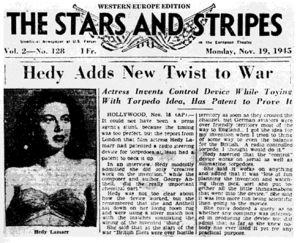
A Hedy Invention

Editors note:
On this day in history (yes, this very day) we have a story from guest writer James Hinton, a history buff who knows some cool things about various subjects. He has previously been published on "Hankering for History" as well as his own site. We are happy to publish his submission about a largely unknown aspect of the life of one of most beautiful movie stars in history. Instead of frequently hopping from bed to bed as many sex symbols do, she invented "frequency hopping." Brains and beauty, what a concept.
Grant Davies

By James Hinton

Cheeky Austrian Hedy Lamarr was a hit when MGM imported her iconic good looks and put them up on the silver screen. She starred as a seductive femme fatale alongside of actors like Clark Gable, James Stewart, and Spencer Tracy. Despite being tasked to sell war bonds, she made fourteen movies during WWII alone. What many people don’t realize is that movies aren't the only things Lamarr made during WWII.

Originally married to a fascist munitions manufacturer, the Jewish born, Catholic raised Lamarr had accompanied her husband to many meetings, learning the ins and outs of weapons manufacturing. Infuriated by German submarine attacks on passenger liners, she put her brilliant mind to work coming up with a solution.

Working alongside of composer George Antheil, Lamarr focused on inventing a means by which torpedoes could be controlled by radio. Such control had been attempted before, but always ran afoul of the same problem time and time again. Any signals controlling the torpedo could be jammed by the enemy. Lamarr’s solution was to rapidly cycle through multiple frequencies in a pattern stored aboard both the torpedo and the ship.

“Frequency hopping” was patented in August of 1942, with plenty of time for it to be adopted and put to use hunting German and Japanese ships. Unfortunately, the U.S. Navy, notoriously sensitive about the poor performance of its current torpedoes, refused to adopt the technology until the 1960s.
The technology did not languish, however. Starting with walkie-talkies, frequency hopping began to see use in radios, simultaneously securing communications against eavesdropping and against multiple conversations talking over one another using the same frequency. These techniques would eventually be adapted for computer communication, resulting in the Wi-Fi and Bluetooth technologies that are key to today’s digital revolution.

Hedy Lamarr passed away in 2000 at the age of 85. She was memorialized as a world-famous actress and sex symbol. As important as her contribution was to film, it is today's cell phones and wireless networks, however, that are her strongest legacy.

Thursday, April 9

How Johnny Chapman Made a Fortune From His Apple Investment

image = American Orchard
By Grant Davies

Once upon a time.. oh wait, I think someone used that opening line for a story already. Let's try this one, I'm sure no one has used it before.

On this day, minus about a month, in 1845 (It was March 11th for you annoying people who insist on actual facts for history stories), John Chapman passed away and into history. Who?

Okay, don't bother Googling his name yet, I'll tell you who he was if you humor me a bit by letting me attempt to build some goofy anticipation first.

John was a hard working, forward thinking young man when he set off across the Midwest in the early 1800's building a real estate empire by exploiting a loophole in a law. No, he wasn't "The Donald's" great grandpappy.

The best way to acquire land back then, or now, is to get it without paying for it. And the best way was to plant something on land you happened across and claim it as your own as soon as the stuff grew into a profitable crop. It was quaintly described as "homesteading." John chose apple trees.  

All right, you clever folks have figured out who he was, Johnny Appleseed. He would plant groves of about thirty trees and sell the land to "settlers" when they showed up later. It was an instant cash crop and we can guess business was brisk, in a 19th century kind of way. 

The apples were brisk too. They were called "spitters." So named because if you bit into one you would immediately spit it out. Terrible for eating, great for making hooch. And back then it was way safer to drink alcoholic hard apple cider than soft microbe infested water. More profitable too.

John was an early animal rights activist and a committed vegetarian. So one of the earliest known liberals, right? Um, no, he held his views because of his devotion to Christianity. He also didn't believe in sex outside of marriage and since he never married...well, he planted apple seeds instead of the human variety. And he kept walking a lot. I guess I would, too.

What a great story! What could go wrong? Well, enter the much beloved IRS in the 1920's who chopped down huge numbers of apple trees across the country to make sure no one could have any fun drinking the medicinal brew. It didn't work, of course. But it helped people find safer alternatives, like booze made in old car radiators.

To celebrate his legacy, order a Redd's Apple Ale next time you go to the Appletree Inn or Johnny's Tap, but don't let on that you know about the evil influence of the profit motive in historical stories on the Disney Channel.

Most of the information in this story was gleaned from an article by Kristy Puchko on Mental Floss.com.

The most recent winner of the 15 seconds of fame award goes to Mike Dixon, history lover and liberty advocate extraordinaire!


Good going Mike, keep 'em coming!


Friday, January 16

A Toast to Temperance

image = women of the 1920s

By Grant Davies

On this day in 1920, the US government enacted a law that sought to regulate human behavior on a scale not seen before in the country. The results were, of course, disastrous. The law was destined to fail because none of the people whose behavior it was designed to alter had any intention whatsoever of complying. And there were a lot of them.

The law in question was the National Prohibition Act, more popularly known as the Volstead Act. It gave teeth to the newly passed constitutional amendment banning the use of alcohol for recreational purposes.

But the new law didn't fail at everything. It succeeded fantastically in many ways. For instance, it worked great at turning law abiding citizens into scofflaws and common criminals. It turned run of the mill ruffians into multimillionaire booze barons. Imbecile thugs like Al Capone became business titans. It spurred employment changes as former bartenders became black market delivery men. It expanded government hiring by turning former productive citizens into enforcement officers and bribe takers.

And let's face it, it made drinking so much more fun! Getting bombed at home and falling asleep in the rocking chair was replaced by sneaking out to speakeasies where knowing secret passwords and escape routes was all the rage. Instead of snoring in that chair, men could go meet naughty girls who liked to smoke cigarettes and dance. Many didn't wear bras either, oh the possibilities.

No other government program caused so much fun to be had by such formerly boring people. Other bad laws  in the future (fill in the blank) never gave such joy. The government finally realized everyone was having too much fun and called the whole thing off in 1933. But don't worry, the government wouldn't make the same mistake twice with other intoxicating substances. They are way too wise for that.

To celebrate "Volstead Day", invite some friends over for a glass (or two) of wine on a Friday evening and propose a toast to temperance. That's what we are going to do tonight. I'd invite you to join us if I was certain you wouldn't show up.

Tuesday, December 30

Art Cashin and the Fifty Year Odyssey

Art Cashin
Storyteller and Trader Extraordinaire
By Grant Davies

On this day in 1964, (that's 50 years ago for you who need a calculator, er..smart phone) a young man was promoted to partner of  P.R. Herzig & Co., and became one of the youngest people ever to have a seat on the New York Stock Exchange.

But he sure didn't "take a seat" or "remain seated" over the next 50 years. His name is Art Cashin. That's right, he's the same guy who writes many of the historical posts for this site. And boy has he ever been busy over that half century.


My own involvement in the trading floor business didn't begin until four years later, so Art was a floor member on the "big board" in the "big apple" before I was even an odd lot boy on the tiny Midwest Stock Exchange in the second city. Art still has his seat and I still have mine. But mine is a recliner in my living room and his is still a membership in one of the most important and historic financial institutions the world has ever known.

Today he is director of floor operations for UBS Financial Services and he appears daily on CNBC. But somewhat more importantly (to me) he is a contributor of wonderful stories to this lilliputian blog. I have been extremely grateful to Art and UBS for allowing me to republish those great stories over the last several years and it's my hope that in some small way this blog has exposed people to his historical musings who otherwise would have never read them.

So, congratulations Mr. Cashin on your 50th anniversary on the floor of the NYSE. And thanks for informing us while entertaining us for all that time.

As he penned in this morning's Cashin's Comments, "It has been a most interesting half century." I wholeheartedly agree! The man is an institution inside an institution.

To celebrate the day, if you happen to see him in his "seat" in some historic Wall Street watering hole, scribbling trading level numbers on the famous cocktail napkins that have informed so many traders for so long, be sure to tip your hat to a Wall Street icon and thank him for the stories you have enjoyed here.

Read more about Art here.

Monday, December 8

LETTER FROM A FREEDMAN TO HIS OLD MASTER

Editors note:
I haven't written anything for this blog in quite some time so I thought I would write about the letter found below. It's a perfect fit for this site because it's great history written with tongue firmly in cheek. I decided not to write about it because I could never improve upon what the author wrote.

The source for the letter is The Freedmen's Book, by Lydia Maria Child. It is republished here under the terms of The Project Gutenberg.* Special thanks to Letters of Note blog.
Grant Davies

LETTER FROM A FREEDMAN TO HIS OLD MASTER.

[Written just as he dictated it.]

Dayton, Ohio, August 7, 1865.


To my old Master, Colonel P. H. Anderson, Big Spring, Tennessee.

Sir: I got your letter, and was glad to find that you had not forgotten Jourdon, and that you wanted me to come back and live with you again, promising to do better for me than anybody else can.

I have often felt uneasy about you. I thought the Yankees would have hung you long before this, for harboring Rebs they found at your house. I suppose they never heard about your going to Colonel Martin's to kill the Union soldier that was left by his company in their stable.

Although you shot at me twice before I left you, I did not want to hear of your being hurt, and am glad you are still living. It would do me good to go back to the dear old home again, and see Miss Mary and Miss Martha and Allen, Esther, Green, and Lee. Give my love to them all, and tell them I hope we will meet in the better world, if not in this. I would have gone back to see you all when I was working in the Nashville Hospital, but one of the neighbors told me that Henry intended to shoot me if he ever got a chance.

I want to know particularly what the good chance is you propose to give me. I am doing tolerably well here. I get twenty-five dollars a month, with victuals and clothing; have a comfortable home for Mandy,—the[266] folks call her Mrs. Anderson,—and the children—Milly, Jane, and Grundy—go to school and are learning well. The teacher says Grundy has a head for a preacher. They go to Sunday school, and Mandy and me attend church regularly. We are kindly treated. Sometimes we overhear others saying, "Them colored people were slaves" down in Tennessee. The children feel hurt when they hear such remarks; but I tell them it was no disgrace in Tennessee to belong to Colonel Anderson. Many darkeys would have been proud, as I used to be, to call you master. Now if you will write and say what wages you will give me, I will be better able to decide whether it would be to my advantage to move back again.

As to my freedom, which you say I can have, there is nothing to be gained on that score, as I got my free papers in 1864 from the Provost-Marshal-General of the Department of Nashville. Mandy says she would be afraid to go back without some proof that you were disposed to treat us justly and kindly; and we have concluded to test your sincerity by asking you to send us our wages for the time we served you. This will make us forget and forgive old scores, and rely on your justice and friendship in the future. I served you faithfully for thirty-two years, and Mandy twenty years. At twenty-five dollars a month for me, and two dollars a week for Mandy, our earnings would amount to eleven thousand six hundred and eighty dollars. Add to this the interest for the time our wages have been kept back, and deduct what you paid for our clothing, and three doctor's visits to me, and pulling a tooth for Mandy, and the balance will show what we are in justice entitled to. Please send the money by Adams's Express, in care of V. Winters, Esq.,[267] Dayton, Ohio. If you fail to pay us for faithful labors in the past, we can have little faith in your promises in the future. We trust the good Maker has opened your eyes to the wrongs which you and your fathers have done to me and my fathers, in making us toil for you for generations without recompense. Here I draw my wages every Saturday night; but in Tennessee there was never any pay-day for the negroes any more than for the horses and cows. Surely there will be a day of reckoning for those who defraud the laborer of his hire.

In answering this letter, please state if there would be any safety for my Milly and Jane, who are now grown up, and both good-looking girls. You know how it was with poor Matilda and Catherine. I would rather stay here and starve—and die, if it come to that—than have my girls brought to shame by the violence and wickedness of their young masters. You will also please state if there has been any schools opened for the colored children in your neighborhood. The great desire of my life now is to give my children an education, and have them form virtuous habits.

Say howdy to George Carter, and thank him for taking the pistol from you when you were shooting at me.

From your old servant,
Jourdon Anderson.


Congratulations to Dave McGovern for winning the 15 Seconds of Fame Award given to contributors of ideas for Cheeky History blog-posts. Thanks Dave! Keep 'em coming.

*This eBook is for the use of anyone anywhere at no cost and with
almost no restrictions whatsoever.  You may copy it, give it away or
re-use it under the terms of the Project Gutenberg License included
with this eBook or online at www.gutenberg.org

Monday, April 14

Mabel, Manley, Martin, and Capone

Image source = SF Library
By Grant Davies

No, the above title isn't the name of a law firm. Nor is it the name of an accounting firm. But today's story has to do with both accounting and the law.

On this day in 1927, a lawyer named Mabel Walker Willebrandt was preparing to argue a case with lasting implications before the Supreme Court of the United States. The case is known as United States v Sullivan.

It seems that Mabel was trying to figure out a novel way to catch a bootlegger named Manley Sullivan and prosecute him for making booze and not paying taxes on the profits. Obviously, if you want a cut of the action from someone else's illegal doings you are either a mobster collecting a street tax or the government doing the same thing. Sometimes it's hard to tell the difference, but I digress. She decided to claim that Sullivan owed Uncle Sam his share and was holding out on him.

Manley's lawyers made the rational assertion before an federal appellate judge named Martin T. Manton that Manley's fifth amendment rights would be violated if he was forced to confess to crimes when filing his income taxes. They also observed that if the government took their cut as taxes they would be guilty of aiding and abetting Sullivan. Many judges agreed, and Martin Manton was one of them. That is how the whole thing ended up before the Supreme Court. Manton said it was incredulous that the government would get part of the proceeds of illegal activities.

The Supreme Court sided with Mabel. This was very bad news for a guy who wasn't even involved. A guy named Capone. You may recall that Al Capone - a fairly successful mobster from Chicago who didn't have the benefit of the IRS to collect his street taxes - was sent to Alcatraz after this precedent was set. But as it turned out, he was just one of the early convictees.

Another notable one was a guy named Martin Manton. Yep, the above named federal judge was later found guilty of taking $186,000 in bribes without including the feds in on the take. He got only seventeen months in prison. Maybe the fix was in.

Source material = One Summer by Bill Bryson

Tuesday, April 8

A Few Things About Charlie Lindbergh

Lindbergh's triumphant return
By Grant Davies

It was eighty-seven years ago this coming summer -that's 1927 for those who jot down such things - that a fellow named Charles Lindbergh beat the odds by avoiding getting lost at sea. It was no small feat since almost everyone who previously tried what he was trying had not beaten the odds.

What Charles was trying to do was cross the ocean without the benefit of a boat. Instead, he carefully made his calculations and hopped aboard a flimsy airplane named the Spirit of St Louis and took off for Paris. That he made it was remarkable.

But this story isn't about how he made it to Europe without ending up in the drink. It's mostly about how he got home again without suffering that fate after taking a safer mode of travel on a ship named the USS Memphis.

It seems that Lindbergh decided to take a walk around the ship after supper one evening. It was an ill-advised notion because the seas were higher than the passengers at the bar that night. As he reached the bow, a series of large waves washed over the deck and he was one lucky Lindbergh not to get washed away himself. Only the presence of a handy lifeline saved him from what should have been his fate on the outward leg of the round trip. He hung on for dear life for about ten minutes before things settled down long enough for him to walk calmly, though briskly, to a safer spot. He later commented, "It was an exciting experience."

For the normally stoical Charles, that was about as emotional as he ever became. It was likely in his genes to be so dispassionate. His upbringing occurred in a home where demonstrative affection was totally absent. No hugging or kissing for the Lindberghs. In fact, when Charles (never Charlie or any other affectionate nickname) went to bed each night, instead of hugging his mother, they shook hands. That kind of warmth just melts the heart.

In the end, Charles returned home as a hero to everyone. Of course, that was before the public's love affair with him ended some years later after he made his Antisemitism known. He revealed it during a well attended speech in Des Moines, Iowa in September 1941. The timing couldn't have been worse. It was just as America was about to go war against some antisemitic folks in Germany.

He went on to father thirteen children, including six with his wife Ann Morrow Lindbergh. His first born was a son who was kidnapped and murdered in one of the most sensational crimes of the time. The rest of his seven children were the result of long term affairs he carried on with three women in Europe (two of them sisters) starting in 1957 and not ending until shortly before his death in 1974.

It's not known if he ever hugged or kissed any them, nor if any of them considered him as much of a hero as the adoring throngs who greeted him when he first returned to America in 1927.


Source information for this post was taken from the excellent book "One Summer" by Bill Bryson.

Wednesday, March 12

When Spying is Suspected, Call in the FBI

By Grant Davies

On this day (-4) in 1971, eight amateur burglars broke into an office in a small town in Pennsylvania and stole a bunch of papers out of the file cabinets. Was this a case of industrial spying or sabotage? Was it a lawyer's office with evidence being stolen in some mafia related court case? Were the papers sensitive dossiers on people who didn't want their private lives surveilled?

Surely, if it was one of those things, the law enforcement professionals would be on the case immediately and quickly nab these first time perpetrators. I mean, if someone was being spied upon, or if dossiers were being kept on private citizens, wouldn't you call in the best detectives you could find? Even perhaps the FBI?

Well, as it turns out the FBI was notified as soon as the crime was discovered. In fact, they were the first on the scene. And in fact, they discovered the crime before anyone else knew about it. Those FBI agents are really sharp, you might be thinking. But for crack investigators like them, this one was easy. You see, it was their own offices that had been burgled and their own papers that were carried away. That kind of crime tends to top the "I'm really, really pissed off about this" list that the FBI keeps in those offices. So you could reasonably assume the perps were caught in a flash and the country was saved from some spy ring of foreign bad guys. Um, you would be wrong about that. In fact, they were never caught.

As it turned out, the FBI were the spies and the people they were spying on were American citizens who were also on an FBI list. It was a list of people and organizations who didn't agree with J. Edgar Hoover's political views.

The papers were turned over anonymously to newspapers and members of Congress and the whole criminal enterprise called the FBI came under the first real scrutiny in its history. Hoover died in 1972, before his involvement in the "FBI inside the FBI" could be fully understood. So the burglars weren't the only ones to escape discovery.

But don't worry, ever since these burglars exposed the government's unconstitutional spying the chance of a government agency collecting information on US citizens unlawfully is a thing of the past. They wouldn't dare do that again.

Information for this story was gathered from the book "The Burglary" by Betty Medsger. Her office was not broken into and no files were stolen.

Tuesday, January 7

It's No Laughing Matter

By Grant Davies

On this day (+23), in 1962, some silly schoolgirls started giggling. What made them start laughing is unclear but one thing is clear:  when they had to close the private boarding school for months on end because so many of the students were affected, it was no joke.

The events took place in Tanzania (then known as Tanganyika), when a few girls started laughing and then crying. So what's the big deal you say? Didn't the girls giggle and cry when you were in school? Well, yeah, but this was different. This was serious laughter (an oxymoron if ever there was one) and it didn't stop for most of them. There were other emotional disturbances and it seemed to be contagious.

It started with just three girls but soon the number afflicted was 75. And there were only 159 girls at the school. That's when they shut the whole place down and sent everyone home. The problem was, when the girls got back to their home towns, people there caught the affliction as well. And it spread out from there.

No one who wasn't exposed to one of the girls (or someone in close contact with them) got the illness. But most who were exposed didn't contract it. Scientists checked out every possible variable they could think of, but no cause was ever found and no one could figure out why they suddenly stopped laughing. In the end, no one died or even became seriously ill.

To mark the occasion, stop by your local comedy club and have a few chuckles, but don't fall down in gales of laughter, you might break your funny bone. And that wouldn't be humerus.


The first winner of the FIFTEEN SECONDS OF FAME AWARD for 2014 goes to Sara Aldworth who suggested this story and pointed us to the information at the Mental Floss website.

Wednesday, December 4

Duryea Wins America's First Car Race

Image = HFMGV.org
By Grant Davies

On this day, (okay, it was on Thanksgiving day, but I'm still catching up) 118 years ago, (put away those smart phone calculator apps; that's 1895) the first car race in America was held in Chicago. The race was won by Frank Duryea. He drove a gas powered automobile of his brother's design.

The race was organized by a newspaper, the Chicago Times-Herald. But the way it was organized was more akin to the way a government organizes a healthcare website. The whole thing was a mess.

On the day of the race -which was supposed to be from Chicago to Waukegan, Illinois, and back- the distance was shortened. Instead, Evanston, Illinois was selected as the midpoint in the round trip. The distance was cut roughly in half, to about fifty miles.

The reason was the weather. As it turned out, eight inches of snow were being dumped on the route by a massive blizzard and whoever was in charge figured out that if no one finished the race there would be no winner. And since the whole affair was cooked up in order to promote automobile sales, it must have seemed like a poor idea to show how unreliable the product was in such weather.

So instead of postponing the race, the geniuses just shortened it. Anyway, the predictable happened when only six of the eighty-nine contestants were able to even show up at the starting line. Everyone was required to wrap their tires in twine to aid traction. Safety first, ya know.

Almost as soon as the race started two of the cars conked out permanently. They were electric cars, which only goes to show the reliability of such vehicles hasn't changed much in 118 years. So off the rest went into the blizzard, sliding into all manner of other conveyances and dropping out one by one. It took in the neighborhood of ten hours for Duryea to cross the finish line. Which just might be about the same speed as today if you drove in rush hour on one of the "expressways."

Frank left his only surviving competitor in the dust, er, the snow. Winning by almost two hours over the only other finisher earned the Duryea brothers the grand prize of $2000, quite a tidy sum in 1895. But more importantly, they grabbed the glory and with it an astounding victory in the sales wars of the coming year. They sold more cars than anyone else in the car business in that year, thirteen.

Today they probably would have been considered "too big to fail", taken over by the government, and forced to manufacture electric cars that nobody wants to buy.

This story was based on information found at History.com. 

Monday, November 4

Old 16 and the Vanderbilt Cup

image = supercars.net 
By Grant Davies

On this day (-2) in 1902, a new offering from a fairly well-known automobile company hit the road for the first time. It was billed as the "best built car in America", and it probably was.

The company was named Locomobile and on that day they sold their first four cylinder, gas powered car, the "Model C." It put out an incredible 12 horsepower. If you were looking for enough torque to make your head snap backwards upon sudden acceleration, and the horsepower didn't deliver, the $4000 price tag surely would. (For those who have a curiosity about how much the Federal Reserve has defended the value of the currency since then, that's $120,040.66 in 2013 dollars. But I digress.)

Anyway, some rich guy in New York was loco enough and had the equivalent of a hundred and twenty grand lying around, so he popped for the Model C. The company was off to the races, literally. More on that later.

The Locomobile Company of America had been around since way back in 1899 (that's three years for you lucky kids of the 60s "new math" programs) and had been producing high quality steam powered cars for folks who just wanted to get around town and weren't in a hurry.

According to History.com, "Steam cars had to warm up (literally: the water needed to boil in order to build up steam pressure) for about a half-hour before the car could be driven, and their water tanks needed to be refilled every 20 minutes or so. They also needed three kinds of fuel: water for the boiler, kerosene to heat the water and gasoline for the pilot light." And that's not counting the acetylene that was needed for the car's "key" which was an acetylene torch to light the pilot. The cars weren't exactly racing material.

So when the company decided that the internal combustion engine was the future instead of steam, they hired a guy named Andrew Riker to design the Model C. It lived up to its billing as a well built car and by 1906 he had manufactured one that lasted well enough to win the "Vanderbilt Cup" two years later. The race was an 11-lap, 258.5-mile test, held on Long Island. It was a very big deal back then.

This car, nicknamed "Old 16," was a tad more powerful than the Model C. It had four-cylinders as well but it put out 10 times the horsepower of the Model C. It was a real speedster that looked fast before it was even running. The car is pictured above and there is a really cool video featuring Paul Newman talking about it below. For more detailed and really cool pictures check this page.

To celebrate the day, take the person riding shotgun in your car to the "Old Sixteen Cafe." When the waitress asks you how you want your coffee, just say, "In my cup." You can skip the Vanderbilt part.


Thursday, October 3

Sayyids Not So

By Grant Davies

On this day (+3) in 1889, a new school opened in the town of Greeley, Colorado. (More on that town in a moment.) It was a two-year college that sought to train new teachers who were qualified to teach in the government school system. The name of the college was State Normal School but after changing names three more times it became the University of Northern Colorado.

The town of Greeley was named after the guy who inspired it, a certain Horace Greeley. You might remember him from the "Go west young man" lesson we all learned in elementary class on the days we weren't daydreaming about a Utopian life where there was no school and the girl next to us in class thought we were something other than the little dweeb we actually were.

But what most of us weren't taught was that Greeley was a Utopian himself. He helped to found several Utopias which were nothing like what would pass for a perfect place in most peoples eyes. And I'd tell you all sorts of other interesting things about Greeley, except this story is not about him. Maybe on another day.

The person who our story is mainly about was an Egyptian student named Sayyid Qtub. Practically unheard of in this country, Sayyid is known in certain circles very well, but more on that later.

The year was 1948 and the place was New York City. Qtub was traveling through that hotbed of morality on his way to (Utopian) Greeley, Colorado to attend the above named school. As one author* describes it, Qtub was a shy and quiet fellow who was traumatized by the whore houses, drug houses, gin joints, and gambling dens.

So he should have been delighted with the relative difference of the Greeley lifestyle where "Classical concerts, free public lectures, sock hops and potluck suppers were the main entertainment."*  Booze was illegal and virtue was all the rage in Greeley. But Sayyid wasn't happy there either; the place seemed like hell to him. He thought the uncovered legs and hand to hip dancing at the church socials was insanely evil.

What he had to say about American Jazz was even less complimentary. He opined that it was "created by Negroes to satisfy their primitive instincts, their love of noise, and their appetite for sexual arousal."* 

Anyway, Sayyid attended school there for only six months before returning to the Middle East where he spent most of his time railing against the depravity of the West. His legacy was in the movement he inspired, something that translates in English to "The Base."

Most of us know it better by it's Arabic translation. It's called al-Qaeda.

*the author is Andrew Carroll. The information for this piece (excepting some background on the school) and all the italicized quotations above were taken exclusively from his excellent book titled Here is Where.
Related Posts Plugin for WordPress, Blogger...