Showing posts with label Interesting People. Show all posts

Friday, October 30

Irish (A)wake


Editors note:

Just in time for Halloween we have a sweet treat for readers. A guest author with a scary story about graveyard shenanigans and Irish ghosts.


By Sara Aldworth


 Come here to me and I’ll tell you the story of Mrs. Margorie McCall.

In 1695, Margorie got a bad dose of it. Sadly she died and was buried in the Shankhill cemetery.

Not long after, a couple of wankers showed up in search of some treasure. They dug up Margorie and discovered a valuable ring on her finger. Unable to slide it off, they decided to remove her finger entirely. As they cut into her, Margorie woke up. Well Jesus, Mary and Joseph! Was it a miraculous resurrection? The hooligans didn’t stick around to find out.

Finding herself awake in a burial plot, Margorie dusted herself off and legged it home.

Soon enough, her family heard a knock on the door. Her husband said, “If your mam wasn’t dead, I could swear that was her knock.” Upon opening the door and finding his newly undead wife, his hair went white with shock.

It was a grand reunion though. Given a second chance at life, Margorie snogged her fella and went on to have another wee one before her final, actual death and burial.

Is the story of Margorie McCall true? Nah, it’s actually twice-buried blarney. 

A search on this story reveals several variations in the retelling. And none have the kind of documentation that would hold up to a historian’s scrutiny. Additionally, would you believe anyone even remotely alive would remain unconscious during an Irish wake? And making another baby with that eejit? Not bloody likely.

Interestingly though, Margorie’s story isn’t all that special. The lady and the ring is an archetype, common in much of European folklore. Furthermore, stories about being buried alive can be found across the centuries and in many cultures. So while Margorie almost certainly only lived and died once, you can be sure the Irish will be slagging ya on this ghost story for donkey’s years.

Sunday, January 26

Give That Man a Prize

Image = Wikipedia

By Grant Davies

On a day just like this, back about fifty years after the 1880s, perhaps circa 1930-ish, a professor at the University of Lisbon decided to do some science.

Before we move on to the actual story, I think it's best to explain how such a precisely imprecise date was arrived upon. I used a calculator. And I guessed at the figures. The 1880s had some meaning for where to start counting, but I'm probably not going to tell you why, just because.

But who cares anyway? It's not actual history, it's Cheeky History. Exact dates require research I'm loath to do.

Anyway, the guy's name was Egas Moniz and he was a scientist, kind of. A former politician, (a republican, lower case) he was a professor of neurology at the above named University. He formed a hypothesis about where in the brain mental illnesses of various kinds originated and how to treat them. Based on the work of others back in the 1880s he decided it was in the frontal lobe of the brain. (Okay, I guess I slipped and told you about the 1880s part, darn it!) So he decided to see if destroying that part of the brain would cure these illnesses. They called the surgical procedure leucotomy. We know it today by a different name. More on that later.

Unfortunately, his scientific method was anything but scientific. According to Bill Bryson in his new book "The Body" (paraphrased), Moniz had no idea what the outcome might be or what damage might be done to the patient. No experiments were done on animals first and he was pretty careless about which patients he chose. (At least one died in an earlier attempt.) He also didn't follow-up well on what the outcomes were. Additionally, he didn't perform the surgeries himself but was keen to take credit for any that were claimed to be successful.

When scientists do science poorly the outcome usually is apparent to scientists who do science well. That can lead to derision and a loss of stature, not to mention income. But that didn't happen to Egas.

Instead, in 1949, he was awarded, (you guessed it) the Nobel Prize. It was for "his discovery of the therapeutic value of leucotomy in certain psychoses." (Wikipedia)

In other words, some of his patients improved a bit on the mental illness they had. Unfortunately they turned into zombies. Perhaps if he had hit them in the head with a shovel it might have had the same effect. (I'm told that leaves a dull impression on the mind) At least he didn't do that.

I don't want to be too hard on him considering the times he lived in. But if he can get a Nobel Prize for crummy science why can't I get a Pulitzer Prize for crummy writing?

To celebrate all the crazy surgeries performed by the others who followed in his lab coats, just slip on down to the "Weird Science Lounge" and when the bartender asks "what'll you have?"  Just tell him, "I'd rather have a bottle in front of me than a frontal lobotomy."


Inspiration for this story came from Bill Bryson's excellent book, "The Body" - "A Guide for Occupants" 

Monday, May 28

The Amazing Talent of Bob Evans

Bob Evans - Supernovae finder extraordinaire
By Grant Davies


Some people have amazing talents that most of us could never image. Bob Evans is one of those people.

I love sausage. And lots of sausage lovers have heard of Bob Evans in regard to making tasty breakfast sausage. But that's not the same Bob as the Bob in today's story.

Our Bob is a retired Minister. He is semi-famous in some circles in Australia for doing serious research and writing books about the history of evangelical revivals.

Even though this is a history blog (kinda), we don't usually write about historical stuff quite that exciting here. Bob's talent for that endeavor is not the one I'm about to amaze you with.

Bob's hobby is finding Supernovae, and he's really, really good at it. Better than anyone else who has ever tried it, so they say. He finds them by looking through backyard telescopes from the small deck of his house in a town not far outside of Sydney, Australia. Other than his telescope his only other tool seems to be his amazing talent for remembering where all those dots in the sky are and noticing when a new dot appears where there wasn't one before. Just in case you aren't as amazed as I am about Bob's amazing memory of where the dots were,  I'll explain.

According to Bill Bryson in his book "A Short History of Nearly Everything" it's explained this way:

(Paraphrased) "imagine a standard dining room table covered with a black tablecloth and someone throwing a handful of salt across it. Think of the salt grains as a galaxy. Now, imagine 1500 more tables like that, each table with random salt tosses, enough to fill the parking lot at Walmart. Now add one grain of salt to any table and let Bob walk among them. At a glance he will spot it."

Now that is amazing! I betcha you can't do that. I can't even remember if I had Bob Evans sausage for breakfast.

To celebrate Bob's amazing talent, drop down to the Star Gazers Lounge and have the Super-duper Supernova Martini. But if you see Bob there and you introduce yourself, don't expect him to remember your name if you meet him again. He says he's not very good at remembering names and his wife says he can't remember where he's put things.

Amazing.

Wednesday, November 30

History, Music, and Redemption

By Grant Davies

On this day in 2011, I wrote a short commentary as a lead in to a video and posted it to my sister blog What We Think and Why. That blog isn't about history but this blog didn't exist back then. Just about every year since then it pops up on my FaceBook feed again. I always feel compelled to share it again.

Today, on the 5th anniversary of posting it, I will add it to this site because it is about history even though it's not too "cheeky."

Some of you have seen it before. Most of you haven't. If you have, you will probably enjoy watching it again. If not, you are about to learn something about History, Music, and Redemption that you might not have known. I present it here unedited. I hope you enjoy watching the video as much as I enjoy posting it.

History, Music and Redemption


Whether it's good ideas, interesting writing, witty humor, important information or videos which deliver some or all of those things, a great blog post is made from great content. On this site I do my best to deliver those things. Sometimes I even succeed.

I write about and post things that I see, hear or just think about. Things I think are important. Many of them concern ideas about freedom or people and events that somehow connect to freedom issues. Some might say this is a political site, but even though it's hard to escape from politics in these times of tumult, I hope it's more than that.

History is one of my loves. So is music. And like so many others, I'm fascinated by the battle between good and evil. So when all three of those things come together in one place, it's impossible to resist sharing them.

One of my favorite musical pieces is the hymn, Amazing Grace. And the history behind it's creation is an incredible story of good, evil and redemption. It's a story I only learned a few years back, long after I fell in love with the melody and power of the song.

The story of John Newton, who wrote the words, is as inspirational as they come. If you don't know the history, do yourself a favor and follow the link, you won't regret it. His fall from grace and final return to receive it again is classic. But as it now turns out, (and as is often the case) I only knew half the story.

The other half of the story concerns Negro Spirituals, the black keys on the piano, the "slave scales" and the writer of the music itself. Someone known only as "Unknown." I will never listen to the hymn the same way again. For me, it used to be special, now it is delicious.

After watching the video below, I can almost feel the pain and suffering of the groaning victims of slavery and the different kind of pain and ultimate redemption of one of those who perpetrated it upon them.

If you feel it too, then this will be better than the usual post on this blog. I hope it will be a great post because of the great content.


Many thanks to Bobbie Rendleman for posting the video link on Facebook.


Many thanks to Bobbie Rendleman for posting the video link on Facebook.


Thursday, March 17

The Story of St. Patrick - Cashin's Version

Editor's note:

It seems there at least as many versions of the story of Saint Patrick as there are story tellers. My story can be found here. Art's story appears below. I hope you enjoy both but please don't compare mine to his because I'm sure to lose in that comparison. If you wait to read mine until you have consumed several shots of Jamesons it will have a better chance.
Grant Davies


By Art Cashin

On this day in the year of our Lord 389, there lived a foin broth of a lad who was.... dependin' on the boyographer ye read: a Spanish peasant, a French herdschild, a Celt from Bannavem or a Gael from Dumbarton, Scotland. At any rate, at age 16 this lad was kidnapped by pirates and sold to one of the only 2500 Irish kings that were reigning at the time.

He served this King as a swineherd mucking out stys and such. For six years he labored in slavery, poorly fed; often beaten; surrounded by people in strange dress who spoke a language he couldn't understand. Then he discovered that six years of such treatment was equivalent to a parochial school education. So he became a Catholic and escaped to France to become a monk.

Upon becomin' a bishop he mistakenly perceived the French to be a bunch of snail eatin', grape juice drinkin', truffle huntin' toads. He longed for the emerald green fields of God's own land and the special amber holy water found there. He returned to Ireland, which was still under the influence of a
group of heathen English druids and a few nocturnal banshees. Nonetheless, he set about convertin' and baptizin'.

Unfortunately, Patrick was not an MBA and did not know the law of diminishin' returns. So he managed to baptize over 120,000 people, built over 300 churches, chased the snakes out of Ireland, developed the shamrock and established a factory to make pennants carryin’ the slogan "Go Notre
Dame".

To celebrate the life of this fabulous man, sing ye some sad songs, talk ye merrily of battles and take ye a wee nip of somethin' till ye might be seein' da little people.

Wednesday, January 20

The Robber Baron of Arizona

James Addison Reavis
By Art Cashin

On this day (-2) in 1896, one of the greatest schemes in American history began to come apart - just as it was on the verge of changing the future of the nation. The scheme was to lay a land grant claim on what was virtually two states - Arizona and New Mexico. But it had all started earlier and simpler.

During the Civil War, a certain James Addison Reavis was kind of the "Radar O'Reilly" of the Confederate Army. He managed to get officer's signatures on passes and requisitions without troubling the respective officers. His....er....penmanship was so good that after the war a pal took him to St. Louis where he showed some....er....interpretive creativity in the office of public deeds.

In 1871, he met George Willing who had a very creative mind but very poor "penmanship." Willing suggested "back signing" and "redrawing" old Spanish land grants. Reavis began to think Willing was thinking small. But he needn't have worried, because Willing died of poisoning shortly thereafter.

Reavis traveled to Mexico and spent some time in missions, monasteries and libraries. He mastered the language and idiom of formal documents of the 1600's and 1700's. Shortly thereafter, he emerged to lay claim to the fabulous "Peralta Grants." And fabulous they were - they showed Reavis to be the owner of nearly 19,000 square miles of Arizona and New Mexico.

Panic set in immediately. The Southern Pacific paid Reavis $50,000 good faith deposit to protect its right of way. The fabled Silver King Mine gave $25,000 as the first year's rent. And when Reavis, amid great pomp, married a "Peralta Heiress" (a poor Mexican girl he set up with phony credentials), he claimed thousands more square miles. Soon there were lines of folks waiting to give money to the "Baron of Arizona." But as your grandmother said "Pride cometh before a fall" (maybe that was my grandmother....er....and come to think of it...it was "four Manhattans cometh before a fall).

Anyway, Reavis got a case of the "haughties" and turned down a newspaper interview. The publisher decided to do a background piece anyway. It was then that he noticed the type-face on some of the documents was of rather recent origin. He then talked an official into letting him see one of the "official documents." He noticed the century old parchment paper had a watermark from a factory in Wisconsin. Since neither the King of Spain nor the original Don Diego Peralta were known to cavort with cheeseheads, an odor ensued.

On this day in 1896, the Baron of Arizona was indicted. He was quickly convicted and sent to prison. Later released, he died a pauper in 1908. There lies a lesson - forge not on recycled paper.


Many thanks to Mr. Cashin and UBS Financial Services who graciously allow his historical musings to be republished on this site. To enjoy more of Art's posts simply click on "Cashin's Comments" in the label section on the sidebar.


Thursday, December 31

Our Old Acquaintance, Bob

By Grant Davies

On this night in 1787, people in Scotland got together, lifted a glass, and sang a song. "Big deal" you say! They do that in Ireland every darn night. Come to think of it, if the joint is open long enough, they do that everywhere a glass of intoxicating beverage is to be lifted. So what makes this night special enough to make note of it?

Well, that was the year the above referenced song was first published. The guy who is credited with writing it, Rab Mossgiel, was rather famous among his fellow Scotsmen for writing other poetry. Rab was just his pseudonym. I guess he liked it better than his real name, Bob. More on that in a moment.

Anyway, the guy actually admitted that he didn't compose it himself, but merely wrote it down after hearing it from "an old man." It's pretty certain that the old man didn't write it either.

The poet's actual name was Robert Burns. And it seems the song was initially sung on January 25th - also known as "Burns Night"-  to celebrate his life and works. But it's normally sung to wave goodbye to the old year and welcome in the new, hopefully better, year.

The song has a rather weird title that is translated from old Scottish English into modern English as "Old Long Since." I guess it made more sense back then. The rest of the words are almost as difficult to piece together too. But most people over a certain age (my age) recognize them well enough.

The song asks the question, should we just forget about our old friends? Well, I guess not. So then, shall we raise a glass and toast them and all the good times we have had with them? Hell, yes!

By now you have probably guessed that the song is the well known New Year's Eve standard, Auld Lang Syne. And the "cup of kindness" is some sort of booze that is being used to toast good fellowship and not forgetting our friends no matter what happens in the new year.

To celebrate the song, go down to the "Auld Neighborhood Inn" with some friends and order "a cup of kindness" from the bartender. Just make sure "it comes to mind" to tip him well. After all, a bartender is a man's best friend and definitely should not be forgot.


  Auld Lang Syne

Should auld acquaintance be forgot,
And never brought to mind?
Should auld acquaintance be forgot,
And auld lang syne?

For auld lang syne, my dear,
For auld lang syne,
We'll tak a cup o' kindness yet,
For auld lang syne.

And surely ye'll be your pint-stowp,
And surely I'll be mine!
And we'll tak a cup o' kindness yet,
For auld lang syne.

For auld lang syne, my dear,
For auld lang syne,
We'll tak a cup o' kindness yet,
For auld lang syne.

We twa hae run about the braes,
And pu'd the gowans fine;
But we've wandered mony a weary fit
Sin' auld lang syne.

For auld lang syne, my dear,
For auld lang syne,
We'll tak a cup o' kindness yet,
For auld lang syne.

We twa hae paidled i' the burn,
Frae morning sun till dine;
But seas between us braid hae roared
Sin' auld lang syne.

For auld lang syne, my dear,
For auld lang syne,
We'll tak a cup o' kindness yet,
For auld lang syne.

And there's a hand, my trusty fiere,
And gie's a hand o' thine!
And we'll tak a right guid-willie waught

For auld lang syne.

For auld lang syne, my dear,
For auld lang syne,
We'll tak a cup o' kindness yet,
For auld lang syne.


Most of the information for this post was gleaned from Carols.org.

Tuesday, October 13

Everything You Thought You Knew About Chris

By Art Cashin

On this day in 1492, Christopher Columbus landed at the Bahamas, believing that he had landed in the islands off Japan. And so history is indebted to a man with a flawed theory who set out on a venture where he didn't know  where he was going, suffered sharp losses on the way and didn't know
where he was when he got there. And he did it all on borrowed money. But if Columbus had things confused, folklore has really muddled what happened.

Back in August of 1492 Columbus had set sail from the port of "Palos de Frontera" on the west coast of Spain with a squadron of three ships to seek the riches of the East.

Error #1 - Columbus headed for a new land. (Actually, he thought he was sailing to China or Japan.)

Error #2 - he was a mighty sailor. (In two earlier launches some of the ships he selected leaked so badly they had to rush back to port and were replaced.)

Anyway, as we all know, the advisors to Ferdinand and Isabella warned their collective royalness that Columbus would sail off the edge of the earth. That's error #3 - actually, they thought Columbus had underestimated the size of the globe and thus would run out of fresh water before he could reach China. Perversely, today's computers indicate the negative advisors were very accurate while Columbus was off by many thousands of miles. Luckily, the unexpected "New World" and its fresh water stood in the way.

So! You say - "So what! Mr. Smarty Pants!" Even if he was not who he seemed to be, nor was much of a sailor, landed in the wrong place and miscalculated much of the way - the great drama was that he did it - and on borrowed money at that. (Op. Cit. Queen's necklace fable.)

Well, despite what your version of Sister Herman Joseph told you that's error #4 - the Queen never hit the hock shop with the jewels. What had really delayed the trip for nine month's was greed - Columbus'. In his employment contract he demanded: 10% of whatever he found, a Knighthood, an
Admiral's title and a Viceroy's title (both to be hereditary) and 10% of the profits on all naval imports thereafter.

When F and I turned him down, he had tried for the same deal at various palaces around Europe. Finally, an advisor convinced Isabella that actuarially Columbus had a good shot of dying on this or some subsequent voyages, so the Queen signed the deal.

To celebrate make note of some valuable discovery you've recently made. Then drop a hefty employment contract on the boss's desk - but don't insist on an Admiralcy - you'll probably look greedy.

Monday, September 28

Sixth Grade History You Probably Forgot

Pompey Magnus
By Art Cashin

On this day (+2) in 48 B.C., one of ancient Rome's most brilliant generals, a certain Pompey the Great landed on the shores of Egypt.

(Mr. Cashin! Yes Sister? Please try to remember the general's name is pronounced Pom-pea; Pom-pay was the name of the city buried by the eruption of Vesuvius in 79 A.D. If you don't pay more attention, you'll never remember enough history to get out of the 6th grade, let alone enough to ever help you in business! Do you understand?? Yes Sister!!)

Anyway, flashbacks aside, Pompey landed in Egypt - kind of "on the run." As you may recall from earlier episodes (or from the 6th grade), Rome was going through a parliamentary crisis. A popular reformer named Julius Caesar was busy dividing Gaul into three parts and sending reform suggestions to Rome. The Roman Parliament (pronounced "Senate") sent a nasty note (on parchment) to said Caesar - saying he had a lot of Gaul and ordering him to come home for a spanking and to please leave his army behind. Said Caesar headed home and took the army with him (across the Rubicon don't-cha know!).

Since that was considered bad form (pronounced formus stunkus), the Roman Senate called upon a former war hero for protection. The guy picked was Pompey the Great (page 6 in your program) - victor over Spanish Rebels (76 B.C.), over a certain "Spartacus" (72 B.C.) and over that early Hitler, King Mithridates (63 B.C.).

Despite this veteran's record, said Caesar made salad out of Pompey at the Battle of Pharsalus (beating him badly with an army half the size of Pompey's). This led Pompey to flee to his last known ally, Ptolemy XIII (pronounced Friday the 13th), King of Egypt and the Nile Delta. Ptolemy XIII (age XV) was at war with his pudgy sister. So, with Ptolemy XIII needing no new enemies (i.e. said Caesar), Ptolemy had his old ally assassinated (i.e. Pompey, who was stabbed as he got off the boat).

Said Caesar sensed that such habits did not make Ptolemy XIII (age XV) a great candidate for new best friend. So, said Caesar threw in with the pudgy sister named Cleopatra.

What happened next...I forget! (Sorry Sister!!)


Many thanks to Mr. Cashin and UBS Financial Services who graciously allow his historical musings to be republished on this site. To enjoy more of Art's posts simply click on "Cashin's Comments" in the label section on the sidebar.

Friday, May 22

Dropping the Hamer

By Art Cashin

On this day (+1) in 1934, a young couple laughed as they drove in the early morning daylight near Arcadia, Louisiana. They had just picked up something to eat and were munching and laughing as they sped through the brightening sunrise. As they pulled around a curve, they were met by a surprise.

The surprise was delivered by a Texas Ranger named Frank Hamer and a group of Louisiana troopers and local cops. Their method of delivery was 10 shotguns, 5 Thompson sub machine guns, and 2 Browning Automatic rifles. A bit much for some post-prom sportsters you might think.

Well it wasn't "post-prom" and the "sportsters" in the car were a couple named Bonnie and Clyde. And, fearing that there might be a video-cam van behind the fugitives….Ranger Hamer ordered his boys to open fire rather than stop, debate or beat the occupants of the car. So they proceeded to pump over 160 bullets into said car. Many apparently struck the car's occupants….Bonnie's corpse was said to have half an uneaten sandwich in its mouth.

When word that Hamer and his crew had killed the famous "Bonnie & Clyde" began to filter out, crowds from the area rushed to the scene. Of course, they were better behaved than today's ruffians. These folks simply began by tearing off the bumper, headlights and fenders of the bullet-riddled car. As the car was stripped, the souvenir seekers got more aggressive....some began to cut off locks of Bonnie's hair....finally someone tried to amputate Clyde's "trigger finger" as a trophy. That was a bit too much even for these cops and they closed off the area.

But if Bonnie and Clyde lacked of sympathy at the site of their death; they also lacked sympathy even among their supposed peers. John Dillinger, rather famous in his own right, hearing of the ambush of Bonnie and Clyde was reported to say --- "Hell, they were just kill-crazy punks and clodhoppers. They gave us decent bank robbers a bad name!"

What a shame Dillinger never lived to see what a well lobbied Congress would do to the Bailouts of 2008/2009. By them - Dillinger was a dilettante!!


Many thanks to Mr. Cashin and UBS Financial Services who graciously allow his historical musings to be republished on this site. To enjoy more of Art's posts simply click on "Cashin's Comments" in the label section on the sidebar.

Saturday, May 16

Lucille and the Blues Boy

image = picshark
By Grant Davies

On this day (-2) one of the most iconic figures of our time passed into history.

This story is about his love affairs. He had many, and they gave him the blues. In fact, he had a love affair with the blues. If none of this makes sense, just stick with me, I'll do my best to further confuse you.

His name was Riley B. King (nickname - The Blues Boy) and the longest affair he had was with his beloved Lucille. He fell in love with her even before she had a name. He actually named her himself. He did so right after he ran into a burning building to save her from the flames. At least that's the legend, and like much of the stuff on this site, it's probably true.

Lucille was named after a girl who, one evening in a dance hall, was the object of admiration of several suitors. So enamored of her were these two men that they took to fighting over her. Such rash behavior rarely ends well and this time was no exception. During the melee a barrel of fuel was knocked over and the resulting conflagration set the stage for Riley's courageous rescue.

He ran into the building, grabbed his guitar, and successfully retreated. Guitar? What about the girl and the combatants? Um,,I don't know. It's said that she made it out, but the two men didn't.

Anyway, he said he named the guitar Lucille to remind himself not to fight over women or run into any burning buildings. Lucille (the guitar, not the girl) became famous when he became famous. And he called every guitar he ever owned by the same name after that.

By now you have figured out that the Blues Boy's nickname was shortened to B.B. and he is known to music fans everywhere as B.B. King. Seems like he did pretty well for a guy who started out working in a cotton field in Mississippi.

Other than his love of Lucille and the blues genre, he loved performing. He averaged about 200 concerts per year well into his 70s and was performing regularly until last October when his health finally caught up to him. He also loved Frank Sinatra who he said opened the Vegas entertainment doors for black musicians. He claimed that he went to sleep every night to Sinatra's song, "The Wee Small Hours of the Morning."

To celebrate his life and music, stop down at the "Dance Hall Blues Club" and stay until the wee hours. And be sure to buy a drink for any girl named Lucille. But if she asks how you are doing, tell her that ever since B.B. died, the thrill is gone.


Much of the information for this story was gleaned from an article by Spencer Kornhaber in the Atlantic Magazine. The rest was gathered from a Wikipedia entry.  The inspiration for writing it was provided by a sometime reader of Cheeky History, Veronica Then.

Thursday, April 30

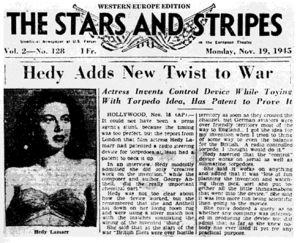
A Hedy Invention

Editors note:
On this day in history (yes, this very day) we have a story from guest writer James Hinton, a history buff who knows some cool things about various subjects. He has previously been published on "Hankering for History" as well as his own site. We are happy to publish his submission about a largely unknown aspect of the life of one of most beautiful movie stars in history. Instead of frequently hopping from bed to bed as many sex symbols do, she invented "frequency hopping." Brains and beauty, what a concept.
Grant Davies

By James Hinton

Cheeky Austrian Hedy Lamarr was a hit when MGM imported her iconic good looks and put them up on the silver screen. She starred as a seductive femme fatale alongside of actors like Clark Gable, James Stewart, and Spencer Tracy. Despite being tasked to sell war bonds, she made fourteen movies during WWII alone. What many people don’t realize is that movies aren't the only things Lamarr made during WWII.

Originally married to a fascist munitions manufacturer, the Jewish born, Catholic raised Lamarr had accompanied her husband to many meetings, learning the ins and outs of weapons manufacturing. Infuriated by German submarine attacks on passenger liners, she put her brilliant mind to work coming up with a solution.

Working alongside of composer George Antheil, Lamarr focused on inventing a means by which torpedoes could be controlled by radio. Such control had been attempted before, but always ran afoul of the same problem time and time again. Any signals controlling the torpedo could be jammed by the enemy. Lamarr’s solution was to rapidly cycle through multiple frequencies in a pattern stored aboard both the torpedo and the ship.

“Frequency hopping” was patented in August of 1942, with plenty of time for it to be adopted and put to use hunting German and Japanese ships. Unfortunately, the U.S. Navy, notoriously sensitive about the poor performance of its current torpedoes, refused to adopt the technology until the 1960s.
The technology did not languish, however. Starting with walkie-talkies, frequency hopping began to see use in radios, simultaneously securing communications against eavesdropping and against multiple conversations talking over one another using the same frequency. These techniques would eventually be adapted for computer communication, resulting in the Wi-Fi and Bluetooth technologies that are key to today’s digital revolution.

Hedy Lamarr passed away in 2000 at the age of 85. She was memorialized as a world-famous actress and sex symbol. As important as her contribution was to film, it is today's cell phones and wireless networks, however, that are her strongest legacy.

Monday, April 20

What Happens When Your Balloon is Too Lowe

Image = Armyhistory.org
By Art Cashin

On this day in 1861, in the cold pre-dawn air near Cincinnati, Thaddeus Lowe climbed into the basket of his large hot-air balloon, the Enterprise. Lowe was already famous in the aeronautic and scientific community as an expert on hot-air (ballooning that is).

But while he was an expert as an aeronaut, as a weatherman he was a schnook. About 20 minutes into the flight, he got picked up by gale force winds that ran nearly 80 mph. On this particular day, the jet stream had developed a sense of humor and swept Lowe (and balloon) all the way to South Carolina. What he thought was a military honor guard out to greet him was in fact a rebel patrol out to arrest him. (Lowe was unaware that the Civil War had started a few days earlier.)

Released when local scientists vouched for his credentials (and his eccentricity), Lowe headed north. But he was smitten by the image of spies in a balloon - peering down on rebel defenses.
He helped found and direct the "Aeronautic Corps. of the Army of the Potomac".

Assuming the wind was right, he or his associates would fly high over enemy lines in a tethered balloon and telegraph directions back down to the Union artillery. The corps made over 3000 such flights and were sometimes shot down. (Lowe was so valuable he was rescued by commandos when that happened to him.) While he survived the war intact, he is believed to have been shot at more often than anybody else in the whole war. Luckily, there were no ground to air missiles at the time.


Many thanks to Mr. Cashin and UBS Financial Services who graciously allow his historical musings to be republished on this site. To enjoy more of Art's posts simply click on "Cashin's Comments" in the label section on the sidebar.

Thursday, April 9

How Johnny Chapman Made a Fortune From His Apple Investment

image = American Orchard
By Grant Davies

Once upon a time.. oh wait, I think someone used that opening line for a story already. Let's try this one, I'm sure no one has used it before.

On this day, minus about a month, in 1845 (It was March 11th for you annoying people who insist on actual facts for history stories), John Chapman passed away and into history. Who?

Okay, don't bother Googling his name yet, I'll tell you who he was if you humor me a bit by letting me attempt to build some goofy anticipation first.

John was a hard working, forward thinking young man when he set off across the Midwest in the early 1800's building a real estate empire by exploiting a loophole in a law. No, he wasn't "The Donald's" great grandpappy.

The best way to acquire land back then, or now, is to get it without paying for it. And the best way was to plant something on land you happened across and claim it as your own as soon as the stuff grew into a profitable crop. It was quaintly described as "homesteading." John chose apple trees.  

All right, you clever folks have figured out who he was, Johnny Appleseed. He would plant groves of about thirty trees and sell the land to "settlers" when they showed up later. It was an instant cash crop and we can guess business was brisk, in a 19th century kind of way. 

The apples were brisk too. They were called "spitters." So named because if you bit into one you would immediately spit it out. Terrible for eating, great for making hooch. And back then it was way safer to drink alcoholic hard apple cider than soft microbe infested water. More profitable too.

John was an early animal rights activist and a committed vegetarian. So one of the earliest known liberals, right? Um, no, he held his views because of his devotion to Christianity. He also didn't believe in sex outside of marriage and since he never married...well, he planted apple seeds instead of the human variety. And he kept walking a lot. I guess I would, too.

What a great story! What could go wrong? Well, enter the much beloved IRS in the 1920's who chopped down huge numbers of apple trees across the country to make sure no one could have any fun drinking the medicinal brew. It didn't work, of course. But it helped people find safer alternatives, like booze made in old car radiators.

To celebrate his legacy, order a Redd's Apple Ale next time you go to the Appletree Inn or Johnny's Tap, but don't let on that you know about the evil influence of the profit motive in historical stories on the Disney Channel.

Most of the information in this story was gleaned from an article by Kristy Puchko on Mental Floss.com.

The most recent winner of the 15 seconds of fame award goes to Mike Dixon, history lover and liberty advocate extraordinaire!


Good going Mike, keep 'em coming!


Wednesday, April 8

Kahn You Hear the Mongols Coming?

image = http://galleryhip.com
By Art Cashin

On this day in 1241 A.D., two great armies met to help decide the fate of western civilization. Okay, so you looked it up, there were three great armies. And, so you know it was in Middle Europe. And, the guys from the East (a chalk bet) were called the Mongols. The cheerleaders for the other guys called them the Mongol Horde. They were not a crowd favorite.

About 25 years before, their leader, a guy named Genghis Khan used their inherent horsemanship and ferocity to conquer most of China. Having quickly run out of rice and opponents they headed west - overrunning Samarkand and 14 other poetic principalities until they engulfed Southern Russia.

Here they heard about grain and riches further west and saddled up. Genghis Khan excused himself without a golden parachute and died. That left the team to his son, Ogotai. The kid saw himself as an administrator and thus hired a grandson of his father (and you thought “Days of Our Lives” was confusing). Anyway the kid's name (he was 32) was Batu Khan and he was the General Petraeus of his day.

So, having ravaged a thousand miles of enemies, Batu Khan found himself, this day, facing the cream of Middle European Knighthood in the Middle Ages. He stood on a small hilltop and looked out on the mass of the Polish and German armies carefully set to repel him. The town was called Liegnitz. The towns' folk, checking the form charts, thought a trip in the countryside was in order.

Thus on this day, Batu Khan's forces swept toward the cream of western chivalry. But before they engaged, the Mongols split and swept to the left and the right. The cream of Europa - probably muttering "What the hell is this!" turned to watch the Mongols speeding away on either side. The joy and laughter was short-lived. A third flank of Mongols now attacked the coalition which was facing the wrong way. The first two forces of Mongols turned to attack them leaving no secure front. The result was a massacre. And the cream of Europa soon became the curds and whey of Europa.

To mark the day, try not to get distracted when you think victory is at hand.


Many thanks to Mr. Cashin and UBS Financial Services who graciously allow his historical musings to be republished on this site. To enjoy more of Art's posts simply click on "Cashin's Comments" in the label section on the sidebar.


Tuesday, February 17

Tamerlane

image = http://medieval2.heavengames.com
By Art Cashin

On this day in 1405 A.D., one of history's most effective, vicious and unlikely conquerors died of overwork. He was one of a succession of Mongol warriors (and claimed to be a descendant of Genghis Khan). He began by conquering his native land, the Russian Republic we now call Uzbekistan (if you don't have a map handy it used to be called Transoxiana or more recently Soviet
Turkmenistan....there, now that its location is clear in your head let's go on).

Once he got control of the old neighborhood, he set up a capital (Samarkand....maybe you heard). He then set about overrunning and plundering all the neighboring areas. In the next 30 years, he conquered over 1/4 of the earth.

But then like most successful folks he had a system. His system was to show up at the gates of your town (with da boys) and announce - "Surrender and you may live…..Oppose me and all will die…..for each moment you take to decide I will behead ten villagers at random".....It was a remarkably effective system. And....if some folks seemed indecisive, he would build a pyramid of their skulls along the nearest trade route. Even without electronic super-highways, the message seemed to get around.

On this day in 1405 A.D., as he was planning to overrun China, exhausted, he fell ill and died. In a terrified Europe, this Mongol Hero Solider was "Tamerlane." Some think this was just a bad translation of his name among his own people....he was "Timur the Lame." He was handicapped from birth and often had to be carried on a platform into battle. In an age when the strongest, ablest and most powerful ruled....this barely educated genius used his mind not his body to rise to the top. We assume that's the last time something like that happened.


Many thanks to Mr. Cashin and UBS Financial Services who graciously allow his historical musings to be republished on this site. To enjoy more of Art's posts simply click on "Cashin's Comments" in the label section on the sidebar.


Tuesday, January 20

Carl Switzer, The Sad End to a Wonderful Life

By Art Cashin

On this day (+1) in 1959, a man was killed by a gunshot during a drunken brawl outside a saloon in California. Even in 1959 this was not a totally remarkable event in California. Unless, of course, the victim was a celebrity, someone that the American public might see as part of its history.

But the police report simply listed the deceased only as one Carl Switzer, a former movie actor. At the time, only grade "B" movie buffs would recognize the name. Not until a few years later, when TV tried to fill time by rerunning old Hal Roach movies, would hotshots be able to say "Hey, that's Alfalfa!" The strident singing star of a series called either "Our Gang" comedies or "The
Little Rascals." His only other notable role was as the teenager who turned the switch that opened the gym floor above the pool in Frank Capra's "It's A Wonderful Life."

Police records don't say if Carl went down singing (in screeching falsetto) "Happy Birthday Mr. Hood - Happy Birthday to Ya."

Many thanks to Mr. Cashin and UBS Financial Services who graciously allow his historical musings to be republished on this site. To enjoy more of Art's posts simply click on "Cashin's Comments" in the label section on the sidebar.

Wednesday, January 7

Zog, King of the Bums

King Zog
image = wikipedia
By Art Cashin

On this day (+3) in 1946, the unemployment rate in the nation of Albania went up by one. No, not one percent, just one. But it was an important one.

The day before, the unemployed person had been the King of Albania. But on that day the nation became a republic, putting the king out of work. Naturally the king was disappointed. Naturally the monarchists were disappointed. And naturally the crossword puzzle editors were disappointed.

Wait! You say, the crossword puzzle editors? Yes, Virginia, the crossword puzzle editors! For the deposed King was none other than the Grand and Imperial Zog.

King Zog was a hit with the social columns even if his people thought him three pickles short of a barrel. And the cruci-verbalists just couldn't get enough of him even after he shortened his surname from Zogu to just plain Zog in 1928 (at his coronation). In fact, Zog and the Zogettes (he had several daughters) might have hung on to become the kind of Royal don'tcha knows that Charles & the late Princess Di had once seemed but in the Balkans, unfortunately, Zog had made a bad bet.

He bet that the leader of a nearby nation would be a friend and defender - but Mussolini used the friendship to conquer Albania. So when World War II ended, the people had stopped calling their king...."Zog the Wise" or "Zog the Competent" or even "Zog the Okay." They called him
"Zog the Bum" and threw him out. That meant the crossword guys would be reduced to using "ex-Balkan" leader for the three-letter clue in the corner.

That was not as much fun and thus, Zog zigged out of the papers completely.


Many thanks to Mr. Cashin and UBS Financial Services who graciously allow his historical musings to be republished on this site. To enjoy more of Art's posts simply click on "Cashin's Comments" in the label section on the sidebar.

Tuesday, December 30

Art Cashin and the Fifty Year Odyssey

Art Cashin
Storyteller and Trader Extraordinaire
By Grant Davies

On this day in 1964, (that's 50 years ago for you who need a calculator, er..smart phone) a young man was promoted to partner of  P.R. Herzig & Co., and became one of the youngest people ever to have a seat on the New York Stock Exchange.

But he sure didn't "take a seat" or "remain seated" over the next 50 years. His name is Art Cashin. That's right, he's the same guy who writes many of the historical posts for this site. And boy has he ever been busy over that half century.


My own involvement in the trading floor business didn't begin until four years later, so Art was a floor member on the "big board" in the "big apple" before I was even an odd lot boy on the tiny Midwest Stock Exchange in the second city. Art still has his seat and I still have mine. But mine is a recliner in my living room and his is still a membership in one of the most important and historic financial institutions the world has ever known.

Today he is director of floor operations for UBS Financial Services and he appears daily on CNBC. But somewhat more importantly (to me) he is a contributor of wonderful stories to this lilliputian blog. I have been extremely grateful to Art and UBS for allowing me to republish those great stories over the last several years and it's my hope that in some small way this blog has exposed people to his historical musings who otherwise would have never read them.

So, congratulations Mr. Cashin on your 50th anniversary on the floor of the NYSE. And thanks for informing us while entertaining us for all that time.

As he penned in this morning's Cashin's Comments, "It has been a most interesting half century." I wholeheartedly agree! The man is an institution inside an institution.

To celebrate the day, if you happen to see him in his "seat" in some historic Wall Street watering hole, scribbling trading level numbers on the famous cocktail napkins that have informed so many traders for so long, be sure to tip your hat to a Wall Street icon and thank him for the stories you have enjoyed here.

Read more about Art here.

Thursday, December 18

Chew on This Story

image = chewing gum facts
By Art Cashin

On this day in 1869, Wm. Semple of Ohio was granted a patent on a form of chewing gum. Americans had long chewed a variation of an old Indian substance - - a combination of sap and paraffin. But like many American invention, somewhere else another guy was working on the same project. In this case the somewhere else was Staten Island.

A guy named Santa Ana, who had a somewhat brief political and military career in Mexico (see “Alamo”), was trying to start a new career in his 70's. And, where is a trendier, more intellectually challenging place than Staten Island. He was hoping to produce a substitute for rubber and had brought along some chicle (itself the sap of a Mexican plant).

He showed it to a local inventor, Tom Adams, this particular sample. But try as he could Adams couldn't make a rubber substitute. So one day while he was hanging out at a drug store (the mall had not been invented yet), Adams heard a kid complain about the paraffin gum. Adams went home, soaked some chicle in licorice and kneaded it into little pellets. The druggist sold out the new sample in six hours. Shortly, America was hooked on "Adams N.Y. Gum No. 1".

To mark the day, try not to chew out an employee. Some can be very snappy. And try not to laugh when someone tells you they always thought "Chicklets" was inspired by a poultry symbol.


Many thanks to Mr. Cashin and UBS Financial Services who graciously allow his historical musings to be republished on this site. To enjoy more of Art's posts simply click on "Cashin's Comments" in the label section on the sidebar.
Related Posts Plugin for WordPress, Blogger...